
If you only followed the political feed, you would think the world is splitting into billionaires on yachts and everyone else eating instant noodles forever. Then you see the data, and the narrative gets awkward, fast.
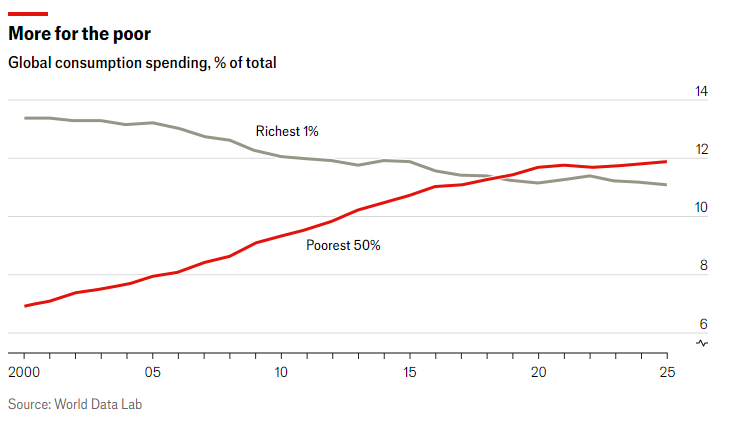
A recent Economist graphic, in the article “The world is more equal than you think”, underscores something many people do not want to say out loud: global living standards have been converging, meaning poorer countries have been catching up in ways that matter for real life.
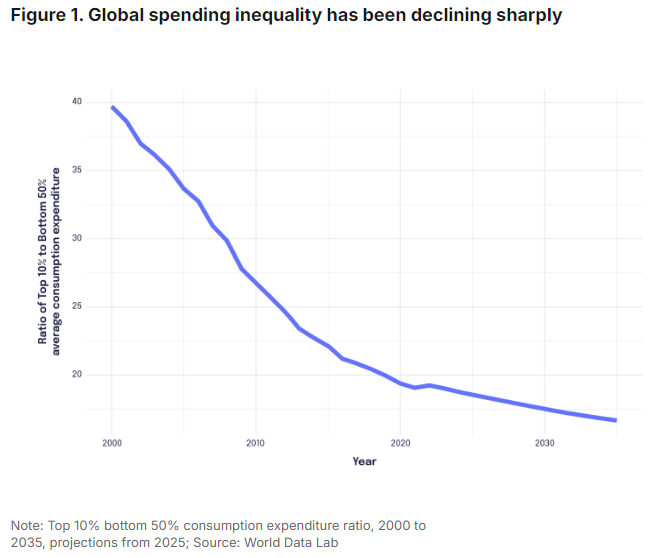
And the newest Brookings analysis adds detail to that picture, showing that global inequality has declined this century in consumption-based measures and linking the improvement to faster growth in places like China and India, as well as broader gains across parts of Southeast Asia and Eastern Europe.
That is not a victory lap. It is a reality check.
The inequality debate matters because it shapes policy. When lawmakers believe the world is growing less fair by the day, they reach for bigger government as the default response. But if the real goal is upward mobility, opportunity, and a decent life for regular people, the biggest obstacle is not “the rich.” It is the policy machinery that blocks competition, inflates costs, and quietly transfers wealth toward the politically connected.
What The Global Story Actually Says
Researchers at Brookings point to two forces behind global inequality trends: the “between-country” gap (the difference in average living standards across countries) and the “within-country” gap (inequality within each country). They find that the between-country side has been an equalizing force because many developing countries have grown faster than advanced economies. They note that in 2000, cross-country income differences accounted for about 70 percent of global inequality, with that share falling as countries converge. They also highlight that the within-country component has been mixed but roughly constant on average since 2000, and is projected to become more important going forward. The share of global consumption for the world’s poorest half rose from about 7 percent in 2000 to 12 percent in 2025. That is still low, but it is movement in the right direction. (If you are scoring at home, “the poor getting more” is not supposed to happen in the apocalyptic version of this story.)
Now layer in a second data stream that is even easier to understand: are the poor in a given country seeing their incomes rise?
The Our World in Data chart tracks the annualized growth rate of real income or consumption for the bottom 40 percent of a country’s population, based on household surveys and the World Bank’s Poverty and Inequality Platform. It is not perfect, but it is grounded in the question people actually care about: are those nearer the bottom moving up?
This is what a healthy “inequality conversation” should sound like: less sermonizing about billionaires, more focus on whether people are gaining purchasing power and options.
The Alternative View Deserves a Hearing, Then a Cross-Examination
Oxfam’s 2026 report, “Resisting the Rule of the Rich”, argues that billionaire wealth is rising rapidly and that extreme wealth can undermine democracy. It claims billionaire fortunes have grown at a rate “three times faster” than the previous five years and that the number of billionaires has surpassed 3,000, while “one in four” people face hunger.
That is the kind of framing that fuels the “eat the rich” mood. But here is the problem: it often treats “wealth” as if it were a pile of cash stolen from everyone else, rather than a constantly changing market valuation of businesses that create products, jobs, and productivity. It also slides between important concerns (cronyism and corruption) and a very different claim (free enterprise itself is the culprit). That bait-and-switch is common.
If the real concern is political capture, that concern is understandable. The solution, however, is not to hand more power to the same institutions that create capture in the first place. The way to weaken oligarchy is to eliminate the deals, carve-outs, and barriers to entry that make oligarchy profitable.
And yes, big tech and “superstar” companies raise real governance questions. Even The Economist has highlighted the “superstar dilemma” in corporate pay and talent markets, a complex issue that is not always pretty. But the cleanest way to discipline superstar firms is not to freeze the economy into a regulator’s version of fairness. It is to keep markets contestable, meaning new entrants can actually challenge incumbents.
The Uncomfortable US Lesson: Growth Beats Dependency
Here is where the inequality myth really breaks down. If the concern is that markets cannot deliver broad progress, then we should look at periods when broad progress actually happened.
A new NBER working paper by Richard Burkhauser and Kevin Corinth provides a blunt historical comparison of poverty trends before and after the War on Poverty. They build a consistent post-tax, post-transfer measure and find that from 1939 to 1963, poverty fell by 29 percentage points, and that the pace of poverty reduction after 1963 was no faster when measured consistently. They also emphasize that the pre-1964 reduction in poverty was driven mostly by market income growth, not by expansions in transfers.
That is not a claim that safety net programs have no value. It is a reminder that the most powerful anti-poverty program is still called a job in a growing economy, supported by rising productivity and competition.
When politics replaces growth with managed redistribution, it can reduce measured poverty in a narrow accounting sense while trapping people in low-mobility systems and higher cost structures.
So what is the real driver of inequality, perceived or real? Policy.
If people feel the game is rigged, it is usually because it is, but not in the simplistic “the rich did it” way. It is rigged through four main channels.
Spending
Government spending is not “new money.” It is a transfer of scarce resources from private activity into political allocation. Once spending becomes the main tool for solving every social problem, the economy becomes a contest for subsidies, grants, and contracts. That is how you get corporate welfare and permanent bureaucracies that grow regardless of results. The cost is what you do not see: businesses not started, wages not earned, inventions not funded.
Taxation
Tax systems loaded with carveouts reward the people who can hire the best experts to navigate them. High rates plus Swiss-cheese loopholes do not produce equality. They produce lobbying. If lawmakers want more fairness, the answer is simpler and more neutral taxation that stops picking winners and losers.
Regulation
This is the quiet cartel-maker. Complex rules do not crush giant firms first. They crush the next competitor. Licensing, zoning restrictions, compliance mandates, and paperwork costs operate like a moat around incumbents. That means less competition, higher prices, and fewer ladders for people trying to move up.
Monetary policy
Central bank discretion can amplify inequality by inflating asset prices and distorting capital allocation. When money is too loose for too long, assets can surge while wages lag, and the gap between owners and non-owners widens. You do not need a conspiracy theory. You just need incentives and a printing press.
Put these together, and you get a simple but unpopular conclusion: if inequality is your headline concern, you should be far more skeptical of the modern policy state.
A Classical Liberal Approach That Actually Helps People Move Up
The goal is not equality of outcome. That is a slogan that turns into control. The goal is mobility, meaning the ability to improve your life through work, saving, entrepreneurship, and choice.
That requires a strict limit on government spending growth so the state stops sucking the economy’s oxygen. A simpler tax system that lowers the penalty on work, saving, and investment. Deregulation that targets barriers to entry, especially in sectors where families feel crushed. Clear fiscal and monetary rules that stop politicians from buying today with tomorrow’s prosperity.
If someone still insists that “inequality proves capitalism failed,” point them to the global convergence evidence in Brookings and the mobility-focused reality behind the Our World in Data bottom-40 growth rates. Then ask the question that separates economics from activism: if government expanded massively and the best eras of poverty reduction were still powered by growth, why are we so confident that more government is the answer?
The punchline is not “stop caring.” The punchline is “stop being fooled.” If you want a world where more people can thrive, the most reliable path is still the boring one: freer markets, real competition, and hard rules that prevent government from rigging the economy while claiming it is saving it.
