
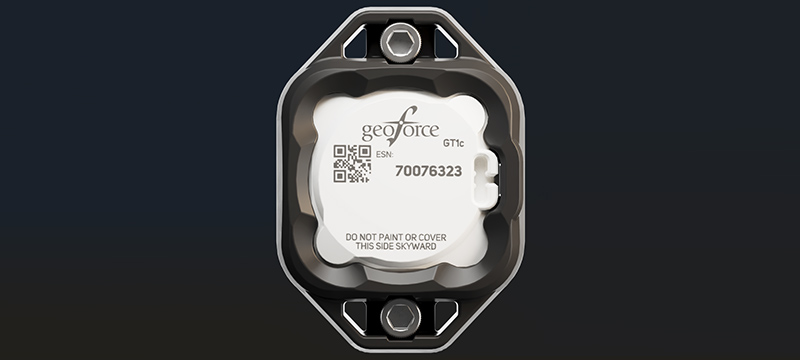
Geoforce has introduced the GT1c, a rugged cellular asset tracker for non-powered industrial equipment that will operate on AT&T’s network. The launch is significant because it extends Geoforce’s industrial tracking portfolio beyond satellite-centric deployments toward lower-cost cellular use cases.
For industrial IoT teams, the hardest assets to digitize are often not the most technically complex machines. They are the unpowered, widely distributed pieces of equipment that move between yards, job sites, depots and field operations without any onboard telematics system to draw from. Tracking those assets has traditionally involved a difficult trade-off: ruggedness and coverage on one side, device and connectivity economics on the other.
Geoforce is addressing that gap with the GT1c, a cellular asset tracker developed with AT&T Business and aimed at non-powered industrial assets. The device is designed to feed location updates into Geoforce’s mobile-enabled asset intelligence platform, giving operations teams visibility into asset location, movement and utilization without relying on vehicle power or existing equipment electronics.
The notable element is not simply that Geoforce has added a cellular tracker. The company already has a portfolio of rugged, battery-powered tracking devices, including satellite-based products for remote and harsh environments. What distinguishes the GT1c is its positioning as a lower-cost, rugged cellular option for asset classes that may previously have been uneconomic to monitor at scale. In other words, the target is not only high-value equipment but also smaller and mid-tier assets that often remain outside formal tracking programs.
A cellular complement to satellite tracking
The GT1c is being introduced as a complement to Geoforce’s satellite tracking devices rather than a direct replacement. That distinction matters. Satellite connectivity remains relevant for field assets that operate beyond dependable terrestrial network coverage. Cellular, by contrast, can offer more favorable economics where coverage is available, particularly for fleets of assets that spend time in industrial yards, rental locations, construction sites or service areas covered by mobile networks.
This is where the AT&T Business relationship becomes operationally relevant. Geoforce says the GT1c will operate on AT&T’s network and represents the first product outcome of a recently announced collaboration between the two companies. For enterprises, that places the device in a carrier-supported cellular IoT framework rather than a standalone hardware launch. For connectivity providers, it is also an example of how industrial asset tracking continues to move from bespoke deployments toward packaged device-platform-network offerings.
Geoforce says the GT1c has a fully encapsulated design, a rugged reinforced bezel, intrinsic safety certification and Zone 0 certification for operation in explosive environments. The company also states that the device is engineered for heavy-vibration settings and extreme temperature ranges. The specification that will draw attention from asset-intensive operators is battery life: Geoforce lists up to 10 years, a figure that directly affects maintenance planning and total cost of ownership for distributed equipment.
Why this matters for industrial IoT deployments
The practical implication is straightforward: if the hardware and connectivity cost is low enough, the business case for tracking can shift from selective monitoring to broader inventory visibility. That is a meaningful change in sectors such as oil and gas, construction, equipment rental, waste management, manufacturing, defense and other field-heavy environments cited by Geoforce.
A pilot with Black Diamond Equipment Rental gives some indication of the intended deployment model. According to Geoforce, the company expanded its tracked inventory by 26% across smaller and mid-tier construction and oil and gas rental assets, with expected time savings of more than 500 hours per year. The figure does not prove universal ROI, but it illustrates the operational problem the GT1c is targeting: time lost locating, validating and managing assets that were previously too numerous or too low in individual value to justify tracking.
The derived insight for IoT buyers is that this type of product changes integration priorities. The challenge is less about instrumenting a machine through deep equipment interfaces and more about attaching a durable, long-life endpoint to assets that may have no power, no operator display and no digital identity in existing systems. For system integrators, the value will likely sit in connecting the location and utilization data from Geoforce’s platform into rental, maintenance, ERP or field service workflows.
For OEMs and industrial equipment suppliers, the GT1c points to another route for adding visibility to deployed assets without redesigning equipment around embedded telematics. For enterprises, it may reduce the threshold for tracking more categories of non-powered equipment. For mobile operators and IoT connectivity teams, it reinforces the role of cellular networks in asset tracking where satellite coverage is not required.
Geoforce says it currently tracks more than 300,000 assets across 110 countries for more than 1,700 customers. The GT1c extends that installed base with a cellular option designed specifically for rugged, non-powered industrial environments. Its real test will be whether the combination of durability, battery life, platform integration and cellular economics can make tracking routine for assets that have historically been managed through manual processes and periodic field checks.
The post Geoforce Brings AT&T Cellular Connectivity to Rugged Non-Powered Asset Tracking appeared first on IoT Business News.
