
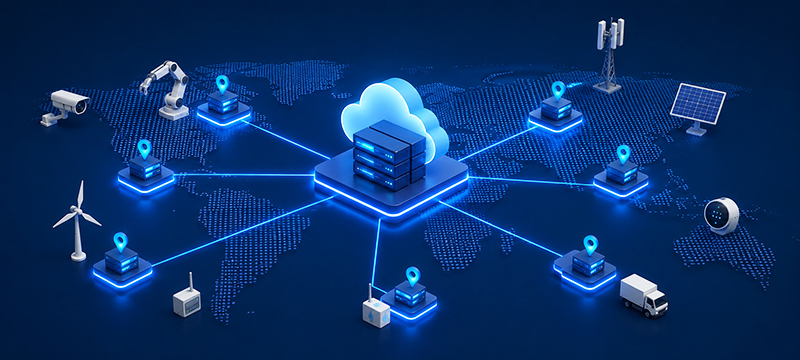
IoT used to be a “small pilot” thing: a few sensors in one facility, one dashboard, one team babysitting it. Today it’s the opposite. IoT deployments span multiple sites, multiple vendors, thousands — sometimes millions — of devices, and a constant expectation that everything works in real time.
That’s the moment when teams run into a stark truth: scaling IoT isn’t only about adding more devices. It’s about reliably moving data, updates, and commands across unreliable networks in different geographies without turning your cloud bill or your support queue into a disaster.
This is why CDN networks are becoming critical for scalable IoT deployments.
IoT traffic isn’t “normal” internet traffic
When people think “IoT data,” they imagine tiny sensor readings. But real deployments involve much more than telemetry:
- Firmware and OTA updates — large files, delivered to fleets
- Device configuration profiles — frequent, must be consistent
- Certificates and keys — security-sensitive, time-critical
- Logs and diagnostics — bursty, often during incidents
- Edge-to-cloud APIs — latency-sensitive, with retries and spikes
Now multiply that by thousands of devices across regions with mixed connectivity. You’re not just running an app; you’re operating a distributed system where failure is normal and speed matters.
CDNs reduce latency where it actually hurts
IoT isn’t always about microseconds, but latency can create real-world problems:
- A smart factory line waiting on a config fetch
- A fleet device timing out repeatedly and burning battery
- Video or image uploads from remote sites clogging the uplink
- A control command arriving late and becoming useless
CDNs help by caching and serving content closer to devices, so instead of everything pulling from one central origin, devices fetch from a nearby edge location. That “shorter path” can be the difference between smooth operation and endless retries.
The big win: OTA updates without chaos
Ask any IoT team what keeps them up at night and you’ll hear “updates.”
When you roll out firmware at scale, systems become stressed.
- You can’t push a 200MB firmware image to 200,000 devices from a single origin without planning.
- You can’t assume every device will download correctly on the first try.
- You need throttling, resumable downloads, and predictable performance.
A good CDN provider is built for distributing large files reliably. They absorb spikes, reduce load on your origin servers, and improve success rates, especially in regions where connectivity is patchy. In plain terms: it makes OTA updates feel less like a “big event” and more like a routine operation.
Better resilience during outages and traffic spikes
IoT deployments behave badly during incidents because that’s when all devices start calling home.
Examples:
- A bug triggers repeated reconnect attempts
- A sensor gateway loses connectivity and then reconnects with a backlog
- A region experiences packet loss and devices start retry storms
CDN edge infrastructure can take pressure off your core systems by handling caching and edge delivery. This doesn’t solve every problem — you still need sane retry logic — but it gives some leeway when things go weird.
Security is another reason CDNs matter
Scaling IoT securely isn’t just “use TLS and forget it.” You’re managing device identity, certificates, and trust chains over time.
CDN networks often come with features that help here:
- DDoS protection
- WAF and bot mitigation — useful for protecting control planes and dashboards
- TLS termination and modern cipher support
- Rate limiting and traffic shaping
For IoT, security isn’t theoretical. A compromised device fleet can become a liability fast, and control-plane endpoints are prime targets.
Edge computing is pushing CDN use even further
Many IoT setups are shifting toward “edge-first” processing, filtering data, running inference, or making quick decisions locally. CDNs increasingly overlap with that world through edge functions and distributed compute capabilities.
That matters because not every IoT message needs to go to a central cloud region. Sometimes you want local routing, local validation, local aggregation, and local policy enforcement. Even if you don’t use edge compute today, designing around edge distribution sets you up for it later.
A practical way to think about it
If your IoT deployment is growing, you will eventually encounter one — or more — of these challenges:
- “Our origin can’t handle OTA update spikes.”
- “Devices in certain regions keep timing out.”
- “Support tickets spike whenever we roll out changes.”
- “We need stronger DDoS/security posture for device-facing endpoints.”
- “We can’t afford to move everything through one region anymore.”
CDNs aren’t a magic fix, but they’re a proven piece of infrastructure for solving exactly these problems at internet scale.
Final take
IoT scaling is less about sensors and more about reliability at the edge. The bigger your fleet gets, the more you need distribution, caching, resilience, and security baked into the delivery layer. That’s why CDN networks are moving from “nice-to-have” to “critical” in modern IoT architectures.
The post Why CDN Networks Are Becoming Critical for Scalable IoT Deployments appeared first on IoT Business News.
