
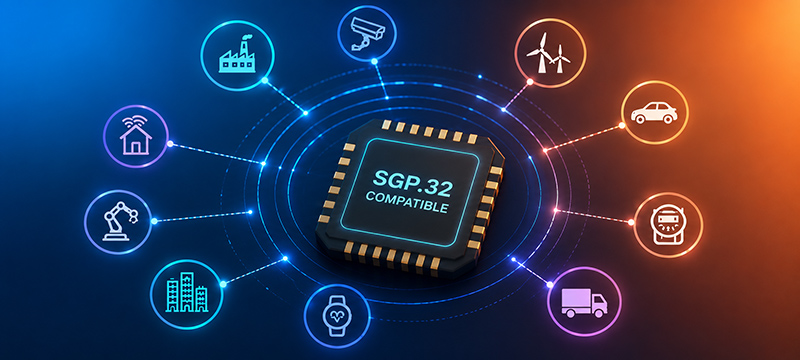
Soracom has made its SGP.32-compatible IoT eSIMs and Connectivity Hypervisor orchestration capability commercially available, moving the offering from pre-order to purchase. The release is relevant for IoT fleets that need remote SIM profile control across regions, operators and long device lifecycles.
For many connected products, the SIM is no longer just a connectivity component. It has become a lifecycle management issue: devices may be manufactured in one country, activated in another, moved across borders, and kept in service long after commercial roaming arrangements or regulatory conditions have changed.
That operational reality is the backdrop for Soracom’s commercial release of SGP.32-compatible IoT eSIMs and its Connectivity Hypervisor eSIM orchestration capability. The company says both are now available for purchase, with SIMs offered in card and chip-type form factors.
Why SGP.32 matters for unattended IoT devices
The significance of the announcement sits less in the eSIM label itself than in the use of SGP.32, the GSMA remote SIM provisioning standard designed for IoT. Earlier eSIM approaches created a mismatch for many deployments. SGP.02 was developed largely around automotive requirements and kept operators closely involved in provisioning. SGP.22 shifted more control toward the device owner, but assumed user interfaces that many headless IoT devices do not have.
SGP.32 is intended to close that gap by supporting devices that operate without screens or local user interaction, while allowing enterprises to manage which profiles are active and when. That is particularly relevant for vehicles, utility meters, asset trackers and connected medical devices, where products are expected to remain deployed for years and may need to adapt to changing network, roaming or compliance conditions.
Soracom’s implementation combines SGP.32-compatible IoT eSIMs with its Connectivity Hypervisor, which uses SGP.32 eSIM IoT Manager functionality to add, remove, manage and switch between multiple operator profiles on remote SIMs and eSIMs. The company says the system can work with third-party mobile network operator profiles and is built on standard eUICC, eIM and SM-DP+ components.
What makes this release different
Many eSIM announcements focus on the availability of a programmable SIM or on global coverage. Soracom is positioning this release around orchestration: the ability to manage multiple profiles through an API and console, and to link remote SIM provisioning with automation rules based on deployment region, regulatory requirement or application need.
That distinction matters because SGP.32 by itself does not remove the operational complexity of managing large fleets. Enterprises still need a control layer for policy, activation, profile switching and exceptions. Soracom’s built-in fallback to a Soracom profile is also a practical detail: if a target profile is unavailable, the device is designed to retain connectivity rather than simply fail the profile transition.
A concrete implication is that connectivity planning can move closer to a software-controlled lifecycle process. Instead of manufacturing different device SKUs for different countries or operators, an OEM can manufacture a single SKU and switch profiles later in the field, according to the constraints of a specific deployment. That does not eliminate the need for operator agreements, but it changes where the decision is made: from production planning to operational profile management.
There is also an important boundary to note. Soracom demonstrated a next release of Connectivity Hypervisor for unified management of connections from multiple operators, including major MNOs, through a single control plane. The company says that capability is built, but broader availability to end customers depends on partner operators completing profile integrations for resale through the Soracom platform. In other words, the architecture is designed for multi-operator control, but the practical breadth of that control will depend on operator-side integration.
Implications for IoT buyers and partners
For OEMs, the most immediate value is SKU simplification and the possibility of shipping devices before the final connectivity profile is fixed. That can be useful when products are distributed internationally or when the same hardware platform is used across several regional variants.
For enterprises and industrial users, the appeal is more operational. A fleet manager can treat connectivity profiles as managed assets, with switching linked to geography, regulation or application requirements. For system integrators, the API-based approach may reduce the amount of custom provisioning logic needed when deploying devices across multiple countries or customer environments.
Connectivity providers and mobile operators may read the announcement differently. SGP.32 gives enterprise customers more direct control over profile selection, but platforms such as Soracom’s still require operator profile integration to expose lifecycle management, usage monitoring and fleet management features in a unified way. That makes interoperability and commercial integration as important as the eSIM hardware itself.
The release reflects a broader shift in cellular IoT: remote provisioning is moving from a telecom back-office function into the enterprise IoT operations stack. Soracom’s commercial availability does not make every deployment simple, but it gives device owners a more flexible mechanism for managing connectivity across long-lived, unattended fleets.
The post Soracom Brings SGP.32 IoT eSIM Orchestration to Commercial Availability appeared first on IoT Business News.
