
You’ve no doubt heard the horrifying stories of dictators who abused their people for personal gain or sheer cruelty. Stalin’s Great Purge, Mao’s engineered famine, and Pinochet’s brutal torture of dissidents are just a few notorious examples. If all dictatorships are hell, a difficult question remains: which offers the better odds of survival, or even prosperity? Is it a dictatorship that tolerates some free-market capitalism, or one built on socialism?
A disclaimer is in order: This is not a defense of tyranny. We should resist it, whatever the form — absolute monarchies, military juntas, or proletarian dictatorships. Whether it’s the few controlling the many or the many terrorizing the few, all policies repressing freedom, silencing dissent, or justifying violence against innocents are inconsistent with our natural rights. They are morally evil and unjustifiable.
“The more the state ‘plans’ the more difficult planning becomes for the individual.”
— Friedrich A. Hayek
Socialism has appeared in many forms — Revolutionary (USSR), nationalist (Germany), agrarian (Cambodia), on and on. Wherever it does not collapse quickly due to its economic defects, it inevitably destroys all political freedoms. Two types of tyrannical regimes emerge: one type allows private property and business initiative, the other squelches them.
Under a regime where the rule of law is replaced by the arbitrary rule of men, the economic system imposed still makes a world of difference. And the contrast is nowhere more vivid than in the struggles of Chile under Augusto Pinochet and Venezuela under Chávez and Maduro.
Let’s start with the fundamental difference: Who controls the economy? In reality, none of the regimes provided consistent legal protection for property owners. Pinochet, Chávez, and Maduro all routinely violated these fundamental rights. But citizens and private entrepreneurs under Chile’s junta had much more control over their personal and economic decisions than those trapped in Venezuela’s socialist economy.
What might seem trivial is, in reality, the difference between meeting your basic needs as a human being and literal starvation. Capitalism means private ownership of the means of production. Under socialism, the state owns everything. Even if political rights are restricted, private ownership is much more desirable for the average person. That’s why life in authoritarian Chile was more bearable than in Venezuela after it embraced democratic socialism.
“Private property creates for the individual a sphere in which he is free of the state.”
— Ludwig von Mises
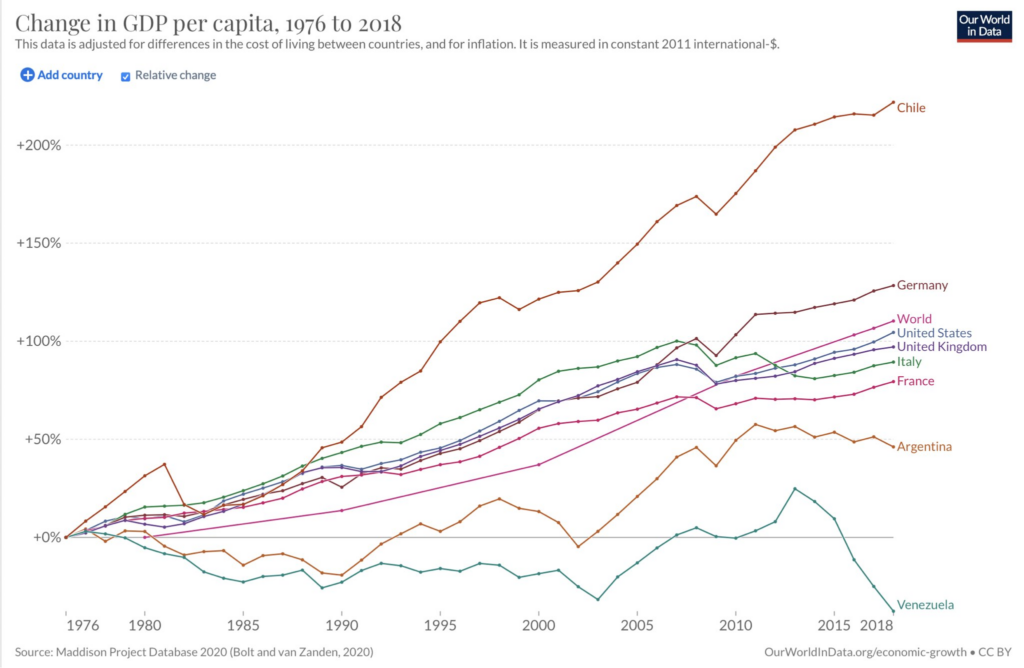
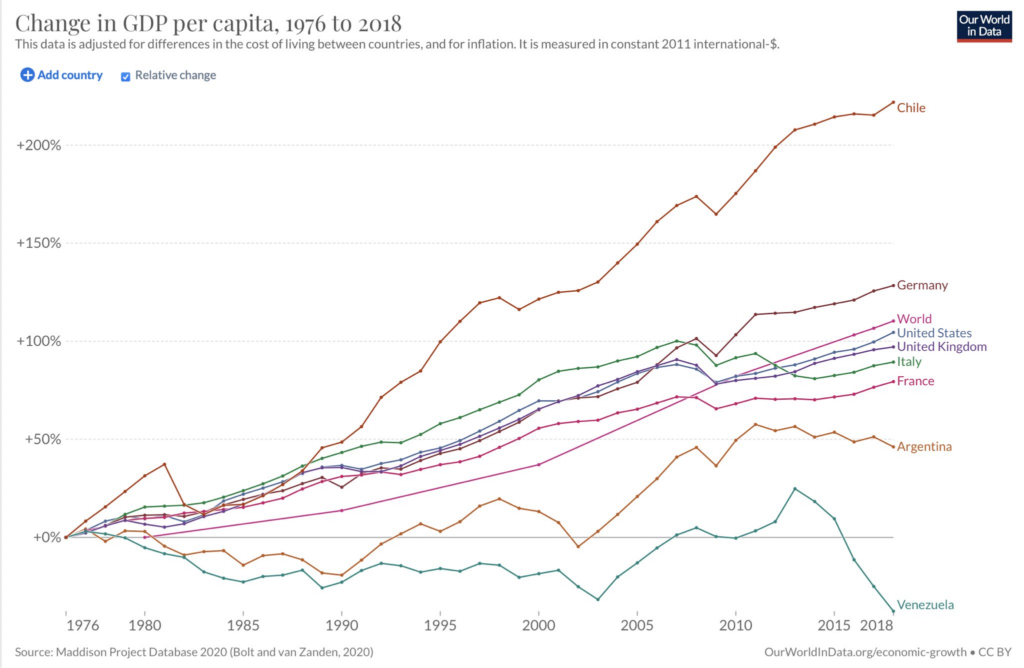
At the start of Pinochet’s rule, the Chileans faced tough economic challenges. None of their difficulties can compare to the mass food and basic supply shortages, hyperinflation, and large-scale emigration experienced by the Venezuelans under socialism. While Chile struggled with poverty and unemployment during parts of the regime, the economy improved significantly following pro-market reforms in the 1980s.
Private ownership of the means of production means that it is possible to start a new business and to compete. This has a positive impact on growth, living standards, and poverty rates. Private business ownership is limited or in name only, if it is possible at all, in socialist countries.
Following advice from Milton Friedman and his “Chicago boys,” Pinochet’s government reduced inflation, slashed tariffs, deregulated the economy, privatized pensions, and introduced private competition into education and healthcare. The economy experienced a deep recession in the early 1980s, but it rebounded and, by the end of the century, it had a solid foundation for sustainable growth.
“Socialism only works in two places: Heaven, where they don’t need it, and hell, where they already have it.”
— Ronald Reagan
Even though Chile was ruled by a ruthless dictator, free-market reforms generated an entrepreneurial boom. The result for ordinary citizens was unprecedented upward mobility. Capitalism, even under a military junta, expanded middle-class prosperity.
Contrast Pinochet’s regime with the damage done by socialism in Venezuela. Chávez took power in 1999 in one of the richest countries in Latin America, blessed with vast oil reserves and a relatively educated population. He inherited a middle-income economy with immense potential. Then Chávez found a solution to a nonexistent problem.
The state expropriated and nationalized thousands of private businesses, including oil, electricity, telecommunications, and agriculture. Chávez demonized private enterprise and implemented sweeping price controls that destroyed incentives to produce. The government managed to purchase political support while oil prices were high. Like many other resource-rich countries with interventionist policies, Venezuela failed to diversify its economy.
When oil prices inevitably collapsed, so did Venezuela. Hyperinflation destroyed prosperity. The economy shrank by around 75 percent between 2014 and 2021. More than seven million people fled the country, most of them college-educated, creating the largest refugee crisis in the Western Hemisphere.
Private property also creates a path to restoring other kinds of liberties. When individuals, not the government, own and control the land and the capital, it is possible to restore political freedoms. Recent research suggests that capitalism has historically been the ordinary citizens’ shield against tyrannical abuses. The study “You Have Nothing to Lose but Your Chains?” published in Public Choice shows that socialism inexorably leads to authoritarian rule and the violation of human rights. Capitalism provides the kind of opportunities that socialist regimes inevitably extinguish — including the opportunity to regain the consent of the governed after a dictatorship.
“Economic freedom is an essential requisite for political freedom.”
— Milton Friedman
Pinochet stepped aside in 1988 after a voter referendum destroyed his claims to legitimacy. Chileans won back their democracy. Chávez and Maduro ignored attempts to unseat them and entrenched their rule by eliminating checks and balances and weaponizing the state apparatus against their opponents. Controlling the productive assets and eliminating alternatives gives a dictator even more power and resources to control the population. Venezuelans now face a failed state with no prosperity and no freedom on the horizon.
The lesson here is not that dictatorship is good. Pinochet is no hero and committed countless acts of brutality. But if you find yourself under the control of a tyrant, you’d better hope he leans toward free enterprise. Capitalism is the greatest poverty-fighting tool ever tried because it’s based on incentives, not ideology. Unlike socialism, private property also props open an escape hatch, offering the hope that the people can someday regain their dignity and autonomy.
