
Economist Thomas Sowell once quipped, “The first lesson of economics is scarcity: There is never enough of anything to satisfy all those who want it. The first lesson of politics is to disregard the first lesson of economics.” And, on Sunday evening, August 15, 1971, President Richard Nixon and his Camp David advisors curated a museum-grade artifact of the second lesson for all the world to see and suffer its consequences.
While economic in nature, the speech was titled, “The Challenge of Peace” in reference to the US troop drawdowns in Vietnam. Its central focus was to explain Nixon’s “New Economic Policy.” In the aftermath of the speech and the policy choices that followed, the plans were more aptly named, “The Nixon Shock.” In the weeks following the speech, the administration unleashed a tidal wave of new government intervention into the economy. These measures have become a masterclass in the consequences of governing officials ignoring the lessons of economics, throwing off the restraints of market discipline, and crafting political promises that defy the laws of economics.
The Context
A title like, “The Challenge of Peace” implies that economies fare better in the fog of war. This sentiment has been called, “Military Keynesianism” and refers to the idea that with elevated spending on armaments comes increased employment along with rising laborer income, followed by a surge in consumer spending. The outcome is a buoyed economy.
The administration had imbibed this view of war spending as Nixon implied the end of the conflict would give way to the so-called “Challenge of Peace.” He clearly articulated this Keynesian doctrine declaring, “America today has the best opportunity in this century to achieve two of its greatest ideals: to bring about a full generation of peace, and to create a new prosperity without war.” This raises an obvious question: Why is war associated with prosperity? Further, one may ask: How did peace come to be viewed as a threat to wealth?
The answers lie with Keynes himself who noted that the path to improving economic conditions didn’t require a novel approach, but could be learned from the lessons of old. In his 1936 General Theory of Employment, Interest, and Money he pointed his readers to the virtues of public expenditure, recounting that “Pyramid-building, earthquakes, even wars may serve to increase wealth, if the education of our statesmen in the principles of the classical economics stands in the way of anything better.” Some of his disciples protest the use of this quote, downplaying the big-spending implications of Keynes’s statement. But, the point here isn’t ever-growing government expenditure. Rather, it’s the inordinate emphasis on aggregate demand and consumption as the driver of healthy, growing economies, eschewing the positive role that thrift, saving, investment, and capital accumulation play that is at the core of this sentiment. For Keynes and for Nixon, the point is that government expenditure, intervention, and policymaking are required to truly ensure a growing economy.
Three Promises
Nixon’s address quickly moved to describe his aims. “We must create more and better jobs; we must stop the rise in the cost of living; we must protect the dollar from the attacks of international money speculators.” In one sense, the assertion that these three goals can be met through political means is nothing unusual. They sound like the campaign promises of every person either running for or already in office. What is noteworthy is that the context presumes that these will be more difficult in a peacetime economy and that more, not less, government interference is the pathway to achieving these goals after the cannons have gone silent. Nevertheless, Nixon’s administration would give it their all. Of course, the “we” he referenced wasn’t the American public, but rather his own administration, attempting to engineer their desired outcomes through the levers of government power.
Each of Nixon’s promises was tied to a policy lever. Jobs would be improved via fiscal measures, regulatory moves would apply to prices in the market, and monetary policy would be used to rescue the dollar. What Nixon didn’t say, and perhaps didn’t grasp, is that these interventions work against one another. Fiscal spending on favored projects drives up prices and wages in those markets, inviting calls for price controls. Those controls, in turn, were thrown into further disarray when the US dollar was unmoored from gold.
It’s a classic case of one intervention breeding the conditions and calls for another.
Three Policy Interventions
The August 15 speech provided an overview of several policy interventions and the days ahead would reveal even more. To better understand the nature of the interference, it’s useful to categorize the measures into fiscal, regulatory, and especially monetary policy.
Nixon would first issue fiscal policy decrees in the broadcast. Chief among them was “a 10-percent Job Development Credit for one year, effective as of today, with a five-percent credit after August 15, 1972.” Further, he proposed a repeal of the seven-percent excise tax on automobiles. Nixon’s stated goal mattered more than the mechanics: higher aggregate consumption. This is a rationale right out of Keynes’s framework, which he reiterated: “This increase in consumer spending power will provide a strong boost to the economy in general and to employment in particular.” To what extent the Camp David meeting discussed the ways in which this additional spending would drive prices higher isn’t completely clear. If they did, the regulatory channel was the blunt instrument they planned to use. And use it, they did.
With the regulatory interventions of wage and price controls, Nixon proclaimed the content of Executive Order 11615: “I am today ordering a freeze on all prices and wages throughout the United States for a period of 90 days.” In the Camp David meeting that preceded the announcement, both Paul Volcker and George Shultz voiced concerns about these moves. Regardless, they were overruled by both Nixon and Fed Chair Arthur Burns. Burns, it is said, desired the President’s approval and enthusiastically supported the New Economic Plan. The swaggering Texan, John Connally, was personally admired by Nixon and was largely responsible for pushing the plan through. Given these interpersonal dynamics, wage and price controls went into the speech and into effect. Later phases created a Pay Board and a Price Commission that would assign prices to be controlled. While the price freeze enjoyed initial popular support, it wouldn’t take long before the laws of economics would reverse that sentiment.
Despite these dramatic policy initiatives, it was Nixon’s directive to Treasury Secretary John Connally to suspend “temporarily” the convertibility of US dollars into gold that earned the announcement’s greatest infamy. Foreign governments had been able, under the Bretton Woods agreement of 1944, to present dollars and redeem them at $35 for an ounce of gold.
On the fiftieth anniversary of the address, economist Alex Pollock neatly summarized the speech and its impact. He lamented that Americans responded to the seismic shift in the global economic landscape with complacency and apathy. Standing in stark contrast to Pollock is Jeffrey Garten, who regarded the radical departure from the Bretton Woods system and the closing of the gold window as necessary and wise. Yet even he recognized that while “It was a good political move by Nixon; it was really bad for the Fed’s reputation.” While the central bank’s reputation may have been sullied in the intervening years, those harmed by the positive, persistent inflation it is responsible for have fared even worse.
The Immediate Reactions
The reaction to Nixon’s speech was swift, and some of the most prominent voices directed their ire toward the introduction of wage and price controls. Writing for the New York Times on September 4, Murray Rothbard fumed, “On Aug. 15, 1971” he announced, “fascism came to America. And everyone cheered.” His concern was over the relative silence on the topic of price controls as much as the policy itself, exclaiming, “The main horror of the wage-price freeze is that this is totalitarianism, and nobody seems to care.”
While they certainly diverged on multiple issues, Rothbard found an ally in Milton Friedman, whose Newsweek column from August 30 explained, “I regret exceedingly that he decided to impose a ninety-day freeze on prices and wages.” Individual prices would keep moving, he argued. But they would be concealed in discounts, poor service, and lower quality. Meanwhile, compensation would go up in other ways through perks and overtime.
The objections to the New Economic Policy weren’t confined to free-market defenders. George Meany, the president of the AFL-CIO, told Time magazine that the plan “takes some money away from Government employees and some more from the poor, then gives it to business. It’s Robin Hood in reverse.”
That October, Manuel Klausner of Reason raised his voice in protest. Speaking of the wage and price controls, he remarked, “In the application of this ‘wishful thinking’ approach to public policy, Americans of all political complexions are supporting the President in his wage-price freeze. They do so because Nixon has done something bold, without regard to whether the action will help or aggravate the problem.”
In the same piece, Klausner exposed “the real source of inflation” as “monetary expansion, pursued by the Federal Reserve Board in issuing new, unbacked dollars into the economy.” Ludwig von Mises’s view on the matter from his Theory of Money and Credit explained that “Inflation is the fiscal complement of statism and arbitrary government…a cog in the complex of policies and institutions which gradually lead towards totalitarianism.”
The Legacy of the Nixon Shock
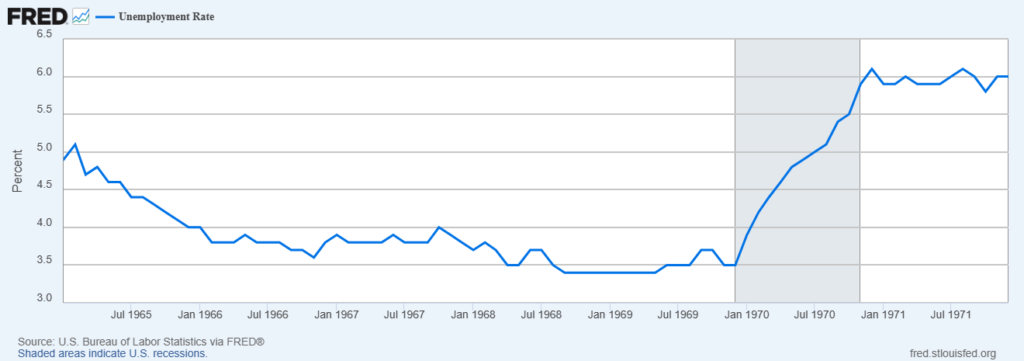
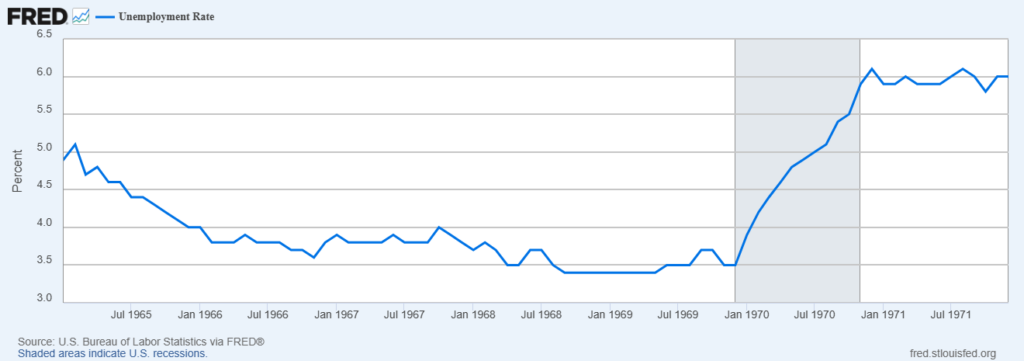
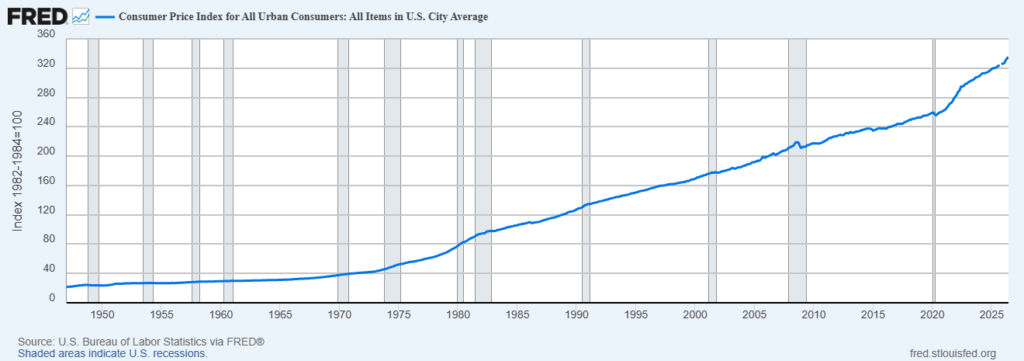
Fifty-five years is long enough to grade all three promises. Unemployment stood at 6.1 percent when Nixon spoke and hit nine percent in May 1975. Inflation was not tamed either. By March 1975, consumer prices were rising at 10.3 percent while unemployment sat at 8.6 percent, a combination the prevailing Keynesian macroeconomics had ruled out and that Milton Friedman had warned was coming. The wage and price freeze didn’t prevent rising prices. Instead, these interventions hid and postponed them. When the controls expired at midnight on April 30, 1974, the suppressed increases arrived at once, and Blinder and Newton later concluded that decontrol accounted for most of that year’s double-digit surge. Only the third promise was kept, and that has been the most damaging legacy of the Nixon Shock.
Nixon’s third promise — to save the dollar from attack — failed spectacularly, though the US Federal Reserve system (not “international speculators”) became its primary assailant. The requirement to convert gold imposed a technical restraint on federal spending and limited inflation, because foreign official holders could demand gold. That constraint died with the dollar’s convertibility. Among its long-run consequences are a shift toward fiscal dominance and endless national debt, both of which are now permanent features of the US economy. No political will appears prepared to change course.
Critics rightly regard the temporary-turned-permanent suspension of the dollar’s convertibility into gold as a ruinous decision. They’ve taken note of the dramatic ethical, economic, and cultural shifts that policy choice induced, not to mention the loss of purchasing power over time that stemmed from the announcement and its execution.
Thomas Sowell’s second lesson has held true for five and a half decades. Nixon disregarded the laws of economics, and in the short run, it won him 49 states in the 1972 election. The politics worked perfectly; the economy fared less well. What remains in the long shadow of the Nixon Shock is a monetary order that enables massive federal and consumer debt and a lost national imagination of what sound money even looks like.
While the situation is dire, hope remains. Calls for a return to sound money haven’t fallen completely silent, and as the monetary crisis deepens, something has to give. If past events are any guide, political ambitions will eventually collide with the laws of economics.
