
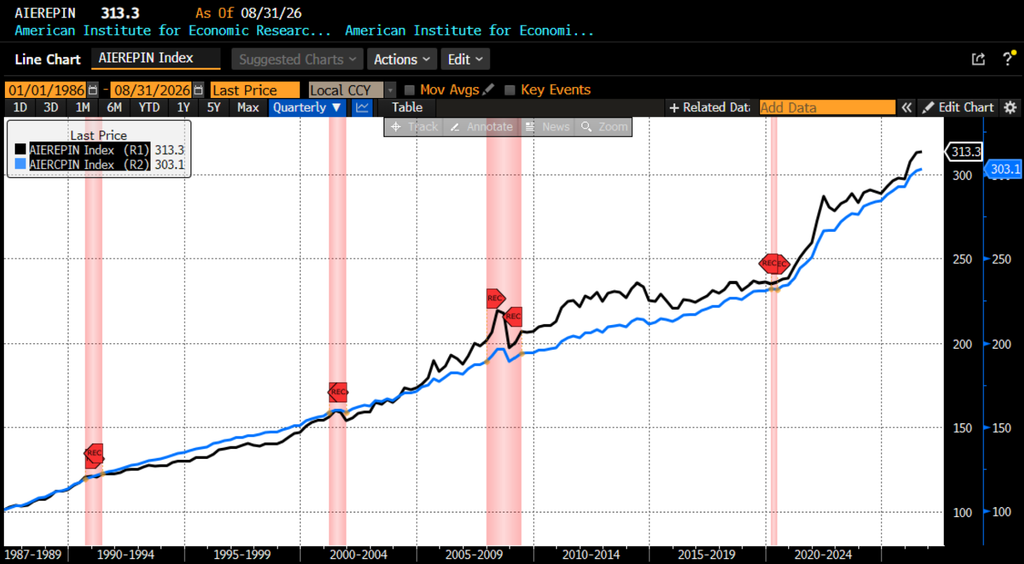
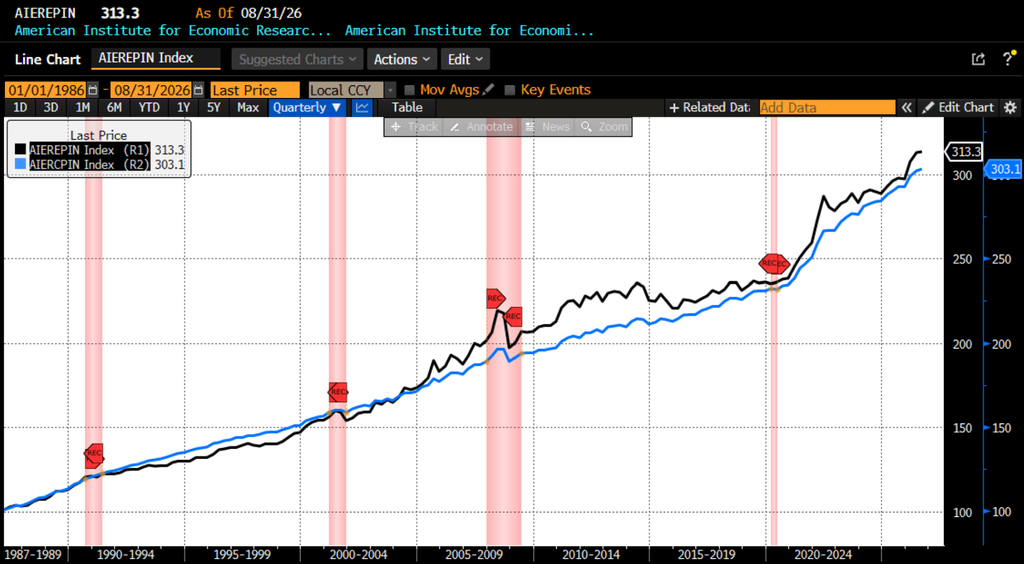
The AIER Everyday Price Index (EPI) rose 0.33 percent in August 2026, reversing two consecutive monthly declines and registering its ninth-largest monthly advance of the past two years. The EPI is now up 5.49 percent year to date and 5.59 percent from August 2025, underscoring the continuing affordability pressure facing households despite the declines recorded in June and July. Beneath the headline increase, price movements were comparatively balanced: 13 EPI categories became more expensive in August, ten declined, and one was unchanged.
The three largest increases among the EPI components were recreational reading materials, up 2.92 percent; motor fuel, up 2.74 percent; and purchase, subscription, and rental of video, up 0.97 percent. The largest declines occurred in nonprescription drugs, down 1.17 percent; internet services and electronic information providers, down 0.70 percent; and admissions to movies, theaters, and concerts, down 0.63 percent. Because of its comparatively large weight, motor fuel was the principal driver of the overall August increase.
AIER Everyday Price Index vs. US Consumer Price Index (NSA, 1987 = 100)
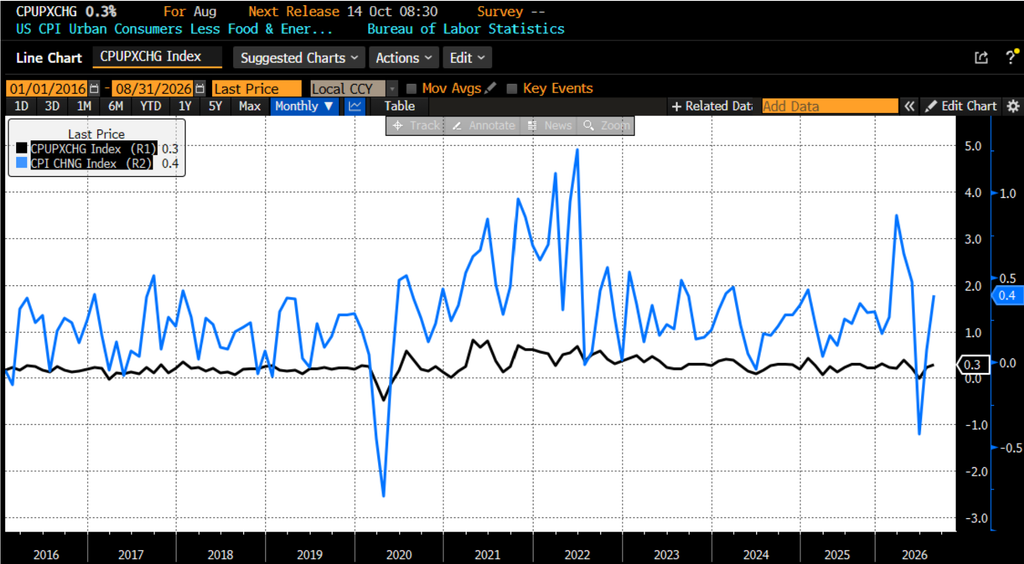
The US Bureau of Labor Statistics released its August 2026 Consumer Price Index report on September 11, 2026. Headline CPI rose 0.4 percent on a seasonally adjusted basis, accelerating from 0.1 percent in July. Core CPI, which excludes food and energy, rose 0.3 percent after increasing 0.2 percent in July. The unadjusted headline index advanced 0.3 percent to 334.980.
Both the EPI and headline CPI moved higher in August, but the composition of their increases differed. Our in-house EPI puts greater emphasis on goods and services consumers buy most frequently.
August 2026 US CPI headline and core month-over-month (2016 – present)
Energy drove most of the increase in headline CPI. The energy index climbed 2.1 percent, reversing July’s 1.5 percent decline. Gasoline surged 3.9 percent and accounted for more than one-third of the overall monthly CPI increase. The advance, however, was not shared across all household energy categories: utility gas service fell 1.1 percent while electricity declined 0.2 percent. That split helps explain why motor fuel dominated the August EPI increase even as its broader fuels and utilities component edged lower.
Shelter rose 0.3 percent, following unusually small increases of 0.1 percent in both June and July. Rent of primary residence and owners’ equivalent rent each increased 0.2 percent. Lodging away from home climbed 2.4 percent, reversing its 2.8 percent decline in July. Shelter and gasoline therefore replaced the energy weakness and subdued housing costs that had restrained headline CPI the previous month.
Food increased 0.1 percent, matching its July pace, while food at home was unchanged. Four of the six principal grocery categories registered increases. Dairy products rose 0.3 percent, nonalcoholic beverages advanced 0.2 percent, and meats, poultry, fish, and eggs increased 0.1 percent, partly reflecting a 2.9 percent rise in egg prices. The other food at home category also increased 0.1 percent. Cereals and bakery products were unchanged, while fruits and vegetables declined 0.4 percent, their third consecutive monthly decrease. Lettuce prices fell another 6.2 percent after plunging 16.4 percent in July.
Restaurant prices continued to outpace grocery prices: food away from home increased by 0.3 percent with full-service meals rising 0.4 percent as limited-service meals were unchanged. The contrast between stable grocery prices and another increase in dining-out costs was also evident in the EPI components, where food at home slipped fractionally but food away from home moved higher.
Core inflation broadened somewhat in August. Communication prices jumped 2.3 percent, airline fares rose 2.7 percent, and education increased 0.8 percent. Used cars and trucks gained 0.4 percent, while new vehicles rose 0.3 percent. Personal care and household furnishings and operations also increased. Offsetting declines were concentrated in medical care and vehicle insurance. Medical care fell 0.2 percent, dental services dropped 0.6 percent, and motor vehicle insurance declined 0.8 percent. Hospital services, physicians’ services, prescription drugs, apparel, and recreation were unchanged. Overall, the figures indicate that August’s firmer core reading extended beyond shelter alone, although several important service categories remained flat or declined.
August 2026 US CPI headline and core year-over-year (2016 – present)
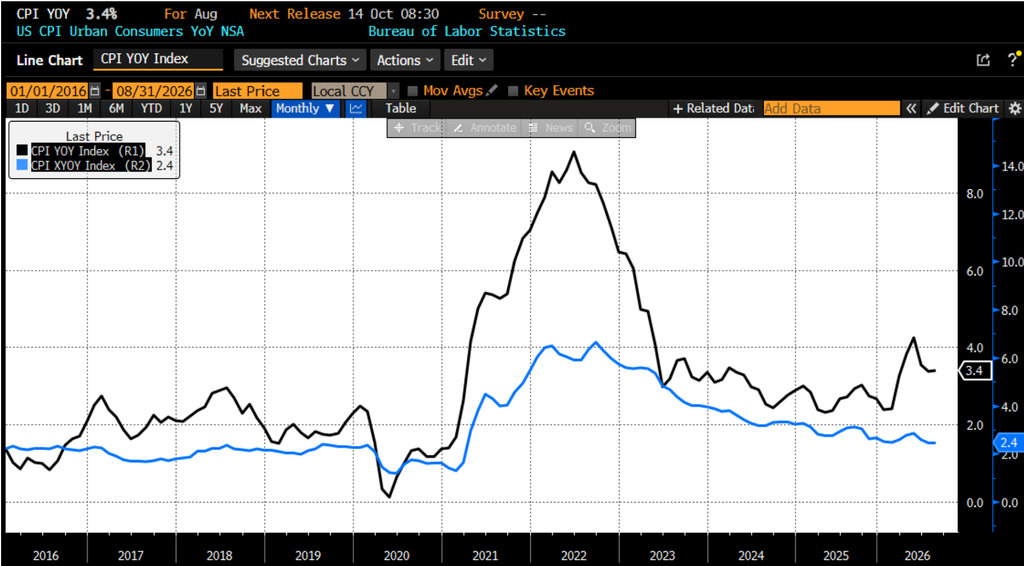
Shifting to the year-over-year benchmarks, in August 2026 headline CPI stood 3.4 percent above its August 2025 level, unchanged from the annual rate recorded in July. Core CPI eased from 2.5 percent to 2.4 percent, suggesting that the stronger monthly reading did not yet translate into renewed acceleration over a longer horizon. Food prices increased 2.7 percent over the year, while food-at-home rose a more moderate 2.2 percent.
Annual grocery inflation remained highly uneven. Nonalcoholic beverages increased 3.7 percent, fruits and vegetables rose 3.2 percent, cereals and bakery products advanced 2.6 percent, and other food at home gained 2.4 percent. Meats, poultry, fish, and eggs increased only 1.1 percent, while dairy products fell 0.3 percent. Food away from home rose 3.4 percent, again exceeding grocery inflation. Full-service meal prices increased 3.5 percent, compared with 3.2 percent for limited-service meals.
The energy index was 16.3 percent higher than in August 2026; that’s up from July’s 14.7 percent rate. Gasoline prices climbed 27.4 percent, with natural gas and electricity rising a much smaller 4.4 percent and 3.8 percent, respectively. August therefore reversed the short-term decline in gasoline while widening the gap between annual energy inflation and the price increases recorded in most other parts of the consumer basket.
Outside the food and energy categories, inflation remained comparatively contained. Shelter rose 3.0 percent over the year, recreation increased 2.7 percent, medical care advanced 1.6 percent, and personal care rose 3.8 percent. Airline fares remained the major outlier, standing 23.4 percent above August 2025 levels. By contrast, used cars and trucks were down 2.3 percent, medical care commodities declined 2.7 percent, and motor vehicle insurance fell 5.1 percent. August thus combined a renewed monthly increase in gasoline and somewhat firmer core prices with an annual core inflation rate that continued to ease.
The August 2026 CPI data strengthens the case for a September rate increase, but not simply because one month came in hot. Energy clearly matters, and the Middle East conflict makes gasoline an especially noisy signal, but price pressure was not confined to fuel. That makes it harder to dismiss the acceleration as an exogenous shock the Fed can safely look through. A central bank can reasonably ignore a temporary oil spike; broader price pressure is another matter.
The larger problem is that the final stage of disinflation may be stalling above the Fed’s target. Interest rate policy can restrain interest-sensitive sectors without being sufficiently restrictive to impact the economy as a whole, particularly if the neutral rate has moved higher. Policymakers should additionally not assume that every inconvenient increase is temporary until proven otherwise. Monetary policy works with long and variable lags, and several August components may reverse. But the experience of the past few years argues against giving persistent inflation the benefit of the doubt indefinitely.
At this point, inflation expectations make the Fed’s judgment more consequential. Inflation need not become spectacularly “unanchored” to cause economic disruption and hardship. If households and businesses gradually begin treating something closer to 3 percent as normal, they will build it into wage negotiations, contracts, pricing decisions, and asset allocation.
Pushing those expectations back down is a considerably more expensive task for the Fed. That creates an unpleasant tradeoff: raising rates risks overtightening an economy already carrying expensive credit; holding steady risks allowing 2 percent to become an aspiration rather than a target. A quarter-point increase therefore looks increasingly like insurance against ending the tightening cycle prematurely. Several subsequent hikes would imply something more important: either the economy’s nominal equilibrium has shifted upward, or monetary policy was never as restrictive as policymakers believed.
