
In 1925, John Maynard Keynes dismissed Marx’s Capital as an obsolete economic textbook that no serious economist would still assign. He was not being contrarian. By the time he wrote that, the marginal revolution of the 1870s had already done the intellectual work: Jevons, Menger, Walras, and later Wicksteed, Marshall, and Böhm-Bawerk had dismantled the labor theory of value that Marx’s entire economic system rested on. Among economists, the argument was over, and Marx had lost it.
So why does Marx remain one of the most cited authors in the humanities and social sciences, a century and a half after his death, in fields far removed from the one where his core claims were actually tested?
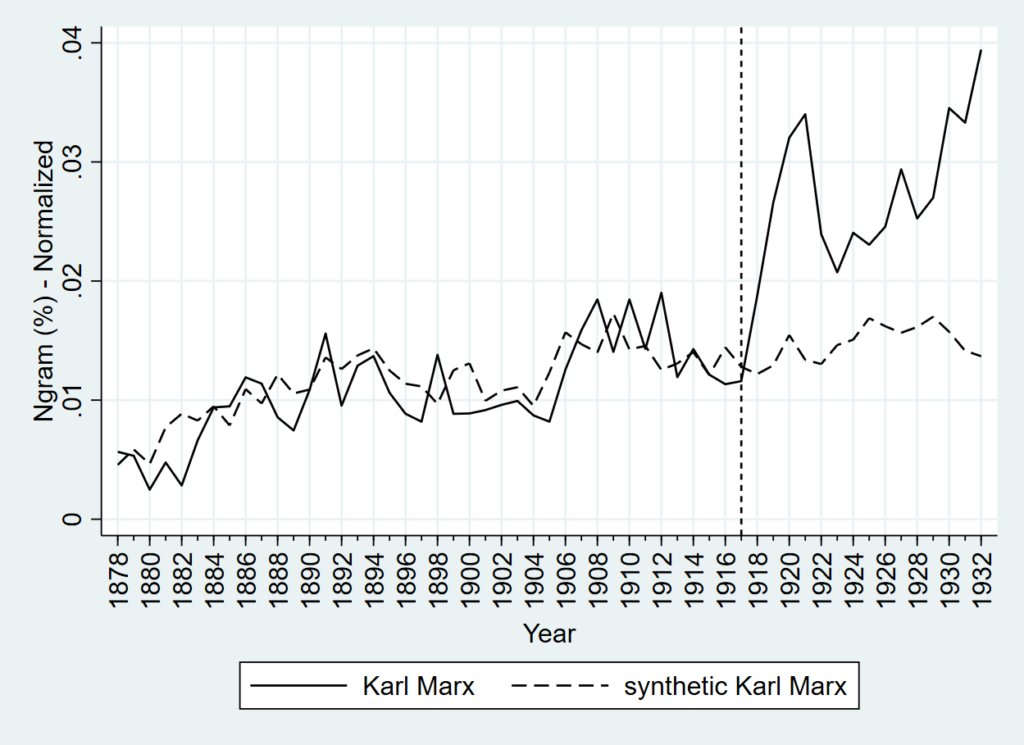
In a 2023 paper in the Journal of Political Economy, Phillip Magness and Michael Makovi offer an answer that is uncomfortable for anyone who assumes Marx’s academic prominence reflects the strength of his ideas. Using Google’s Ngram data, Magness and Makovi built a “synthetic Marx” — a weighted composite of contemporaneous socialist writers, including Ferdinand Lassalle, Johann Karl Rodbertus, and Oscar Wilde — chosen because their citation trajectories tracked Marx’s closely before 1917. Then they watched the lines diverge. After the Bolshevik Revolution, Marx’s citations broke sharply away from those of his peers, while the synthetic composite did not. Before 1917, Marx was known among rival socialist factions and the economists who had already rejected him. After 1917, the Russian state needed a founding philosophy for what was, in plain terms, a seizure of power. It got one, retroactively, by making Marx a household name.
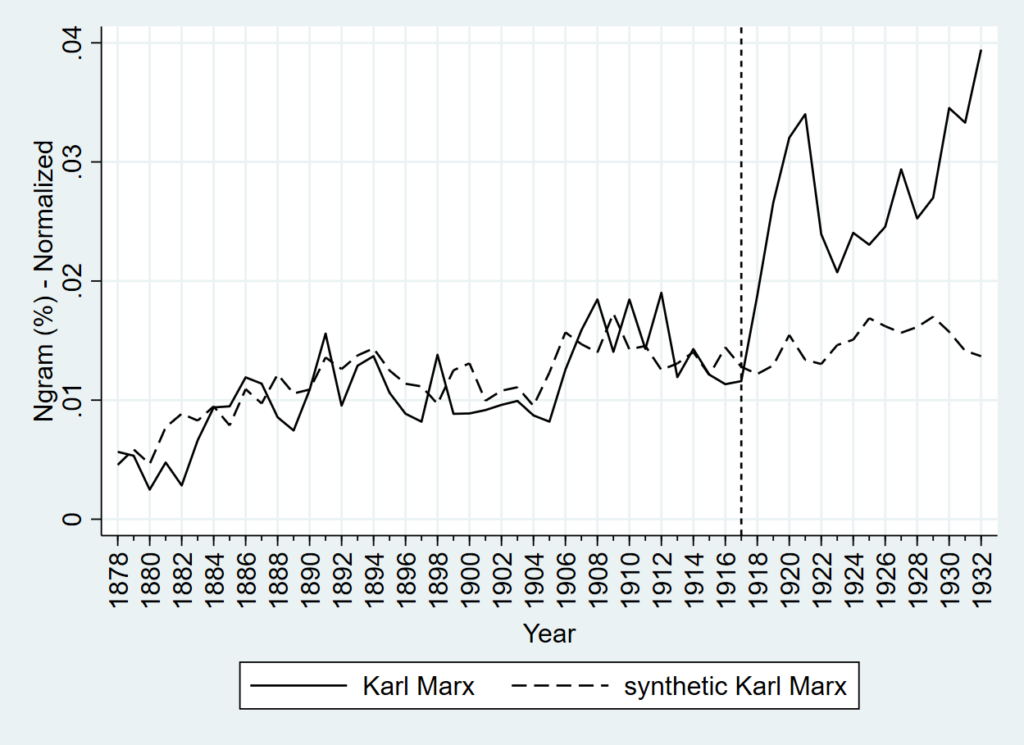
This does not mean Marx had no standing before the revolution. Economics journals are the notable exception, as the data show, and Magness and Makovi say so directly. What the data support is narrower and more interesting: a discontinuous jump in mainstream legitimacy, arriving exactly when a regime needed intellectual cover, not when a new argument appeared to justify one.
Here is the part economists tend to miss and sociologists tend to bury. If the economic argument was already lost by 1917, and the Soviet revolution supplied prestige rather than proof, what explains the durability of Marxist categories in Western universities, long after the calculation debate was settled and the planned economies it inspired had produced the most devastating body counts of the twentieth century?
Antonio Gramsci, writing from a fascist prison in the 1920s, supplied the theory, whether or not the activists who later popularized it had read him carefully. Gramsci’s puzzle was why the revolution emerged in backward, agrarian Russia rather than in the advanced industrial economies Marx had predicted. His answer was that Western societies are governed as much by cultural consent — manufactured through schools, churches, and media — as by direct economic control. A frontal seizure of the state, as in the Bolshevik model, would not work in the West. What would work was a slower “war of position”: a patient occupation of the institutions that manufacture consent.
The phrase most associated with this strategy, the “long march through the institutions,” is usually credited to Rudi Dutschke, the German student leader of the 1960s. The attribution deserves more scrutiny than it gets, though not the scrutiny most people reach for. It is not that Gramsci was unavailable to Dutschke: a partial German translation, Philosophie der Praxis, appeared in 1967, the same year the phrase began circulating. What is thin is the documentary record of Dutschke reading him. His own diaries mention Mao, Guevara, and Lukács repeatedly, but Gramsci not once. The clean lineage from Italian prison cell to German student movement to American faculty lounge, repeated confidently by everyone from Douglas Murray to Christopher Rufo, may still be a retrospective construction: a coherent-sounding pedigree assembled after the fact for a strategy that needed one, much like the intellectual pedigree the Bolshevik Revolution constructed for Marx himself.
What is not in dispute is the strategy itself and its adoption across the postwar academic left: if the economic argument could not be won, the institutions that credential, publish, and platform could be occupied instead.
This is where a discipline should ask an empirical question rather than an ideological one. Occupying an institution is not the same as running it well, and a strategy built around capturing credentialing bodies produces a specific, predictable personnel problem. Peter Turchin’s structural-demographic theory, developed across Ages of Discord and subsequent work, describes what happens when a society produces far more credentialed aspirants to elite status than there are elite positions to hold them: law graduates, doctorate holders, activist-class professionals, all competing for a fixed and often shrinking number of visible slots. In a crowded field of similarly credentialed rivals, competence is not what cuts through. Conspicuousness is. Extremity is a cheap, reliable signal in a market where everyone already has the degree.
The Democratic Socialists of America did not arrive at their current position by accident. In August 2025, DSA delegates voted to remove a long-standing constitutional provision barring Leninists from entry, ratifying what internal factions had already been calling a “big tent” strategy: build numbers first, sort out doctrine later. The numbers came. By the summer of 2026, DSA-aligned candidates had unseated sitting Democratic incumbents in New York and Colorado, captured a Senate nomination in Maine over a sitting governor, and pushed a mayoral runoff in Los Angeles — a run of primary victories serious enough that Third Way’s Jon Cowan and Matt Bennett, hardly outside agitators, warned in The Washington Post on July 1, 2026, that the party needed to confront the movement rather than continue appeasing it.
The DSA does not dispute the strategy. It has a name for it. Since 2019, party resolutions have called it the “dirty break“: run candidates on the Democratic ballot line while building the independent infrastructure to eventually field a worker’s party without it. NYC DSA Co-Chair Gustavo Gordillo said as much plainly to Spectrum News ahead of the June 2026 New York City primary. He describes a party that contests Democratic brokered primaries and caucuses with Democrats in the legislature because “we don’t agree with the way the Democratic Party establishment organizes or runs its party apparatus.” Former DNC Chair Jaime Harrison’s reply captured the establishment’s dawning recognition of the threat: “If you hate the Democratic Party,” he said, “please don’t run for our nomination;” and don’t expect to use the party’s resources, volunteers, or infrastructure to build something else.
That establishment alarm, coming from people who spent careers building the institution now said to be slipping from them, is not a new phenomenon. It is the third act of an argument that began with a revolution needing a philosophy, continued with a strategy for winning institutions instead of arguments, and now produces the exact personnel outcome the strategy predicts. A field of candidates all fluent in the same activist vocabulary, competing for a shrinking number of winnable seats, does not reward the most competent entrant. It rewards the most conspicuous one.
Marx’s ideas didn’t triumph in institutions because they are true. They triumphed because the institutions that credential, publish, and platform never had to ask whether they were.
