
It’s been eight years since the Supreme Court struck down the Professional and Amateur Sports Protection Act (PASPA) in Murphy v. National Collegiate Athletic Association. Since then, dozens of states have legalized sports gambling, and the number of participants, and sums at stake, exploded.
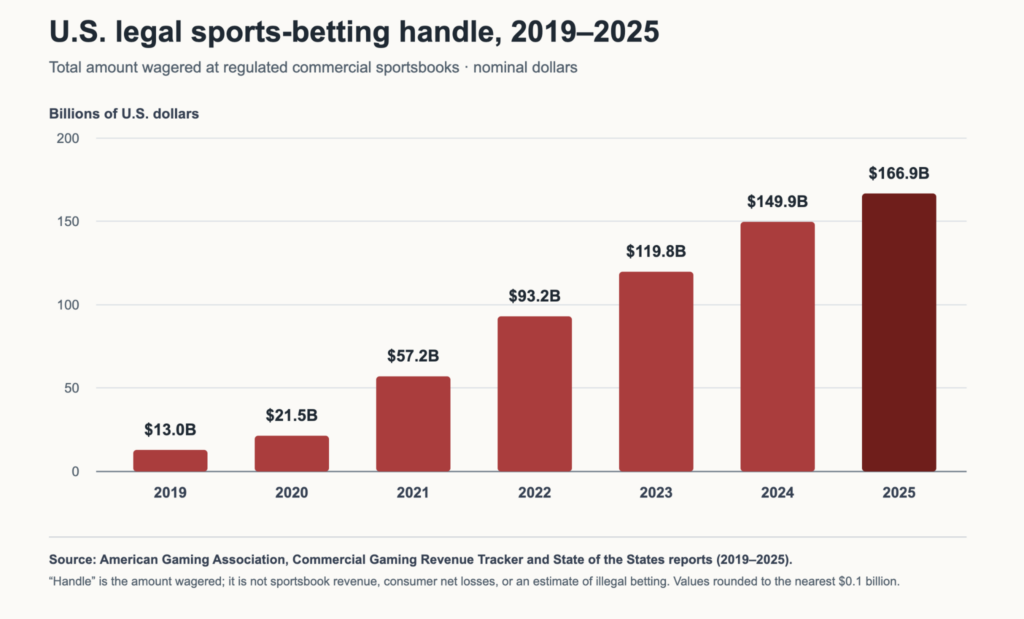
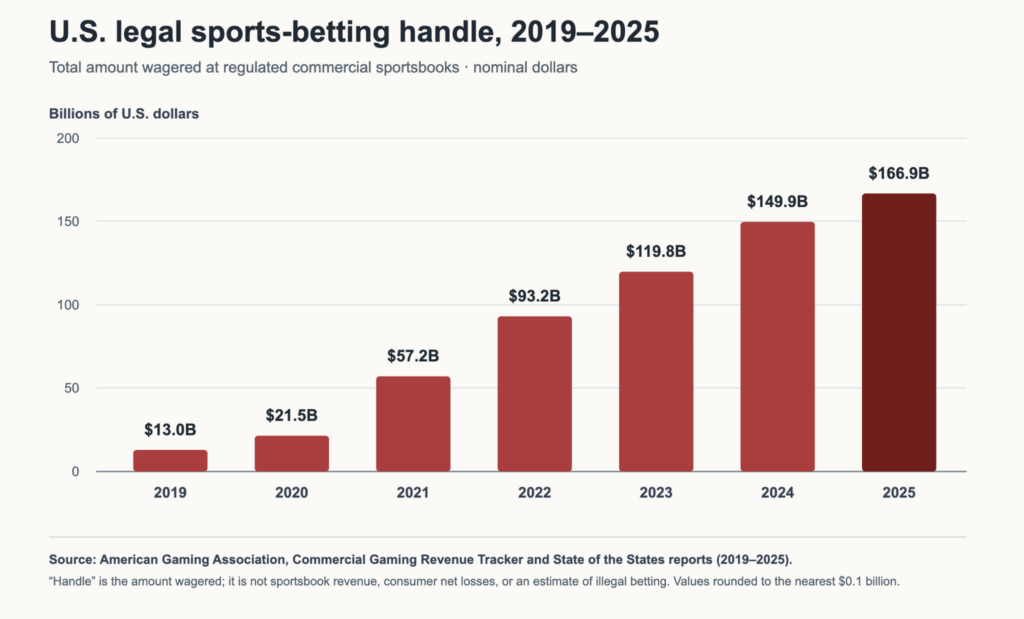
Americans wagered $13 billion on sports in 2019 and a staggering $167 billion in 2025 — a nearly 13-fold increase. Much of that growth has coincided with the proliferation and aggressive advertising of sports-betting apps, which have made wagering easier and more addictive than ever. In 2024, 19 out of every 20 sports wagers were placed online.
No small group of high-stakes gamblers is driving the surge in sports betting. According to a recent survey of Americans by the Siena Research Institute (SRI) and St. Bonaventure University, more than half of men aged 18 to 49 said they had an active account with at least one online sports-betting service, and 46 percent said they were actively betting.
Gamblers lose. The financial harms of sports betting are rising with the participation and stakes. The same survey found that 42 percent of active bettors said they felt like they were spending more than they should. A separate nationwide survey found that one quarter of sports bettors reported they were unable to pay a bill after losing wagers. Studies have found that legalization, a state-by-state experiment, tracks approximately with increases in credit card debt and overdrafts. Another study found legalized gambling increases the risk of bankruptcy by 25 to 30 percent, others even higher. To make things worse, online sports betting leads to even more pervasive consequences. Online gamblers, as compared to in-person gamblers, were 15 times more likely to have missed a bill payment. And a 2024 study found that in states with legal online betting, bankruptcy rates rose 28 percent and debts reported for collection amounts increased eight percent. These effects seem to emerge roughly two years after legalization.
Beyond, and because of, family finances, gambling has been linked to anxiety, depression, and suicidality. A recent paper found that states that legalized sports betting documented a roughly nine percent increase in intimate-partner violence. Another study using Child Protective Services data associated legalized sports betting with a five to seven percent increase in substantiated reports of child maltreatment. And a study examining professional sporting events from 2017 to 2021 found that crime rates were higher during and immediately after games in states that had recently legalized sports betting, with especially pronounced increases following unexpected game outcomes.
But what’s the solution? One may acknowledge that an activity has significant economic, social, and emotional harms while still rejecting two necessary conditions for regulation: 1) that the government has the moral authority to regulate the activity in question (i.e., whether there is some fundamental right involved) and 2) that the regulation will achieve its intended goals.
In general, the answer to both questions is no — the government has too often intruded on individual rights and too frequently enacted regulations that fail to achieve their stated ends. Sports gambling, however, is a rare exception. Some regulation is justified. Even one of the most expansive defenses of individual autonomy — Robert Nozick’s Anarchy, State, and Utopia — allows for limited regulation. Nozick’s minimal state is restricted to protecting the rights to life, liberty, property, and contract. A just government may prevent force, theft, and fraud, adjudicate disputes, and enforce voluntary agreements. It may not, however, redistribute wealth, impose a particular conception of morality, or protect competent adults merely from harming themselves.
Sports gambling falls within Nozick’s framework because it involves commercial transactions in which sportsbooks control the information, contractual terms, and mechanisms governing bettors’ property. Regulation can therefore ensure that sportsbooks disclose material terms honestly, avoid fraudulent or deceptive practices, and honor the agreements they make with bettors. Such regulation does not prevent adults from gambling for their own good or to meet the policymakers’ moral code. Disclosure and transparency regulations would protect the property and contractual rights necessary for individual choices to be genuinely voluntary. But those regulations must remain limited.
Limited regulation means that sports gambling can remain available without being placed in everyone’s pocket, or aggressively marketed through constant notifications. The policy choice, therefore, is not simply between complete freedom and prohibition.
The law can treat something deemed a “vice” in four broad ways:
- Freely available and actively promoted.
- Legal but subject to modest imposed costs or delays;
- Illegal but only loosely policed
- Illegal and aggressively suppressed
Since Murphy, states have moved sports betting from the second category to the first. But while the last two categories — outright prohibition — have generally failed, the largely unregulated approach adopted by many states has created its own problems. Following legalization, states have reported a more than 60 percent increase in diagnoses of gambling disorders.
Limited reforms could move sports gambling back into the second category — legal but subject to modest regulation. Regulators could preserve the freedom to bet while requiring platforms to:
- display a bettor’s net deposits, winnings, and losses
- disclose the conditions attached to promotional offers
- stop describing bets as “risk-free.”
- prohibit deliberately predatory “dark patterns”
- allow withdrawals to be as easy as deposits
- honor voluntary timeouts and self-exclusion for those quitting
As to the second condition for regulation — its efficacy — several studies suggest that these limited measures can reduce high-risk gambling. One study, for instance, found that among online sports bettors who used voluntary self-control tools, 10.6 percent stopped betting altogether, while those who continued betting significantly reduced both the number of daily bets and the total amount wagered. Another study examining transparency requirements for online betting found that bettors shown clear statements summarizing their bets, wins, losses, and net results wagered 4.9 to 7.6 percent less than bettors shown no statement. Similarly, after Britain required every licensed online operator to participate in its national self-exclusion system, an independent evaluation found that 75 percent of registrants stopped gambling online and 48 percent reported they’d stopped gambling completely.
One common defense of sports gambling among small government advocates rejects punishing millions of responsible participants for the destructive behavior of a relative few. But there is no need to prohibit sports gambling to reduce those most significant harms. The reforms outlined above would leave responsible bettors free to wager while making it harder for sportsbooks to obscure losses, manipulate decisions, or disregard limits bettors have imposed on themselves.
Targeted reforms would protect principles of markets and economic liberty, including transparency, fair dealing, and good faith contracting. Such disclosures preserve the freedom of bettors rather than restricting it. Adults should remain free to wager, but betting platforms should be limited in their efforts to obfuscate ‘voluntary’ in the exchange.
