
Congress is pursuing another reconciliation bill before the midterm elections. It should demonstrate to Americans that their elected representatives are willing to make the difficult choices needed to put the nation’s finances on a sustainable path. Instead, it risks becoming yet another reminder that Congress continues to rely on shortcuts and shiny objects to distract from the structural entitlement reforms the budget requires.
America’s debt crisis is a fiscal problem, and it is also a political one. Washington doesn’t lack ideas for reducing deficits. It lacks the political courage to enact them.
This latest reconciliation package — the third of this Congress — illustrates the problem.
Budget reconciliation was created to help Congress make difficult fiscal decisions by allowing certain budget legislation to advance with a simple Senate majority. Properly used, it can overcome procedural obstacles that often prevent meaningful deficit reduction.
Instead, Congress increasingly treats reconciliation as another escape hatch: a vehicle for financing new priorities while postponing structural reforms.
That’s what Republicans have decided to do with this ‘go small and go home to campaign’ bill. They are using a deficit reduction process to increase spending with empty promises that fraud reduction will eventually make the numbers work. In the meantime, they are leaving the underlying drivers of debt on their crisis trajectory.
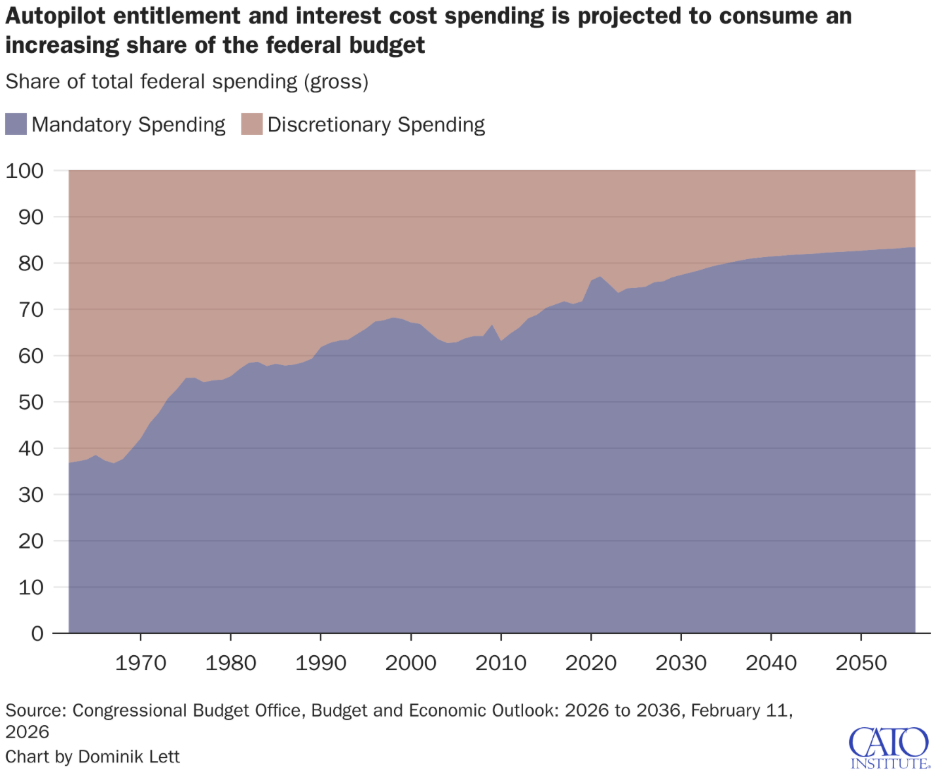
Most federal spending now operates on autopilot, growing automatically regardless of Congress’s annual appropriations process..
Social Security, Medicare, Medicaid, and other mandatory programs grow automatically under current law, while interest costs compound as debt accumulates. Together, these programs account for the overwhelming majority of projected spending and debt growth, now and into the future.
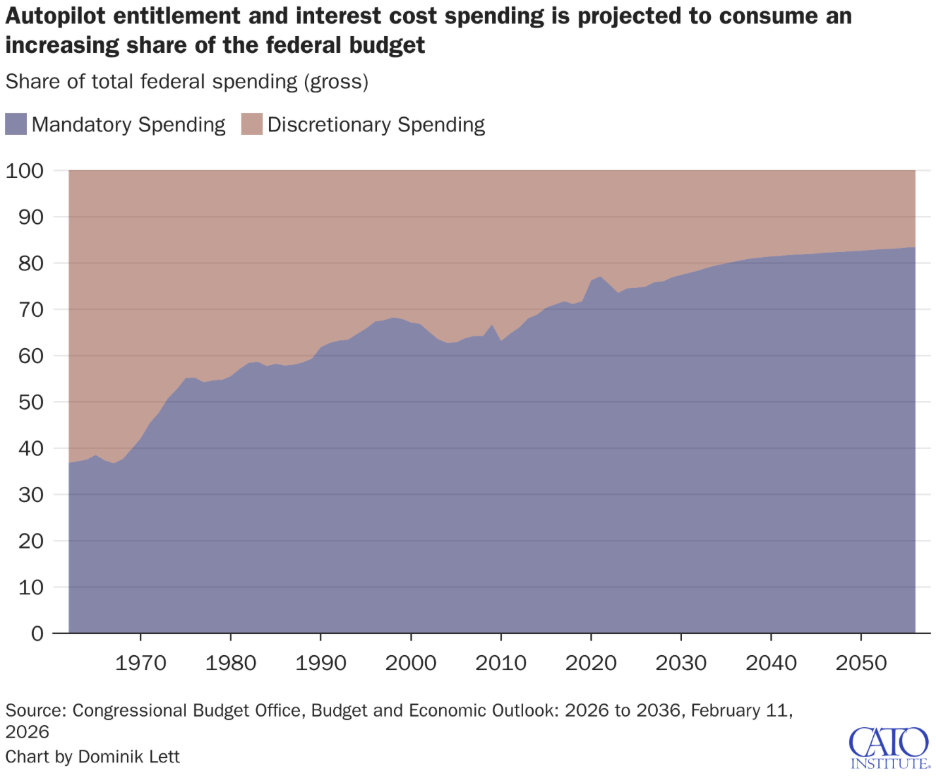
Over the next decade, Social Security, Medicare, Medicaid, and interest costs will account for $3 of every $4 in additional spending and together consume nearly all federal revenues. Their growth fuels federal debt held by the public, which is as large as the nation’s annual economic output and will surpass its all-time World War II high of 106 percent of GDP by 2030, before ballooning to 120 percent by 2036 and 175 percent by 2056.
Autopilot spending is only part of the problem. Congress has largely abandoned budgeting for both discretionary and mandatory spending.
Congress is supposed to debate and pass twelve annual spending bills, forcing lawmakers to prioritize programs within a fixed discretionary budget. Instead, lawmakers lurch from one continuing resolution to the next, from shutdown threat to shutdown threat, before ultimately passing a year-end funding package that largely preserves the ineffective status quo.
Rather than confronting the increasingly dismal fiscal trajectory, Congress has gravitated toward political distractions that relieve legislators, at least temporarily, of responsibility.
The Department of Government Efficiency (DOGE), we were told, would cut trillions in spending that Congress had failed to achieve. It didn’t happen. Now congressional leaders argue that the executive’s “war on fraud” will get the job done.
Reducing waste, fraud, and abuse is unquestionably important. Taxpayers deserve honest accounting of their money. Opportunities for reining in the structural drivers that enable fraudulent spending abound.
But fraud is not what is driving two-trillion-dollar deficits. America’s debt problem originates in entitlement spending commitments that grow faster than the economy and faster than revenues can reasonably keep pace. No amount of rooting out improper payments can substitute for reducing unsustainable entitlement commitments.
The pattern of Congress reaching for procedural shortcuts to avoid fiscal discipline keeps repeating. Legislators avoid annual budgeting through continuing resolutions. They avoid scrutiny through last-minute legislation. They avoid structural reforms by pointing to fraud. And Congress increasingly avoids bipartisan legislating by relying on reconciliation to overcome the Senate filibuster.
Each step may be politically convenient. Together, they represent an institution gradually surrendering its constitutional responsibility over the nation’s finances.
If the Republican trifecta cannot leverage reconciliation to enact meaningful spending reforms that reduce fraud, waste, and abuse in federal welfare programs, Americans should not expect it to summon the political courage to tackle Social Security, Medicare, and Medicaid through the ordinary legislative process.
And yet, failing to fix these unsustainable entitlement programs is not an option. The federal government cannot indefinitely promise faster-growing benefits while financing them with borrowing. Delaying reform does not eliminate tough choices. It only makes the tradeoffs harsher, shifting larger costs onto younger workers, future taxpayers, and beneficiaries themselves.
Every common workaround makes it easier to increase spending or postpone reform. Congress should create a process that makes it easier to reduce spending instead.
That is the idea behind an independent, BRAC-style fiscal commission, modeled after the Base Realignment and Closure (BRAC) process that shuttered obsolete military bases following the Cold War. The military base closure commission succeeded because lawmakers recognized that politically difficult but economically necessary decisions require a process that makes them politically feasible. They established an independent commission, tasked it with clear goals and strong guardrails, and adopted a default approval mechanism to set reforms in motion.
BRAC succeeded in doing what most members knew needed to be done but could not find a political pathway to accomplish. A Budget Reduction and Control (BRAC) process holds promise for correcting the US fiscal trajectory before bond markets force far worse choices.
The federal debt is ultimately a symptom of institutional failure. Congress has turned processes meant to enable difficult fiscal decisions into vehicles for politically easier choices that fuel spending and debt.
Until Congress either rediscovers the political courage to govern — or creates a process capable of overcoming its own paralysis — the nation’s fiscal outlook will continue to deteriorate, regardless of which party controls Washington.
