
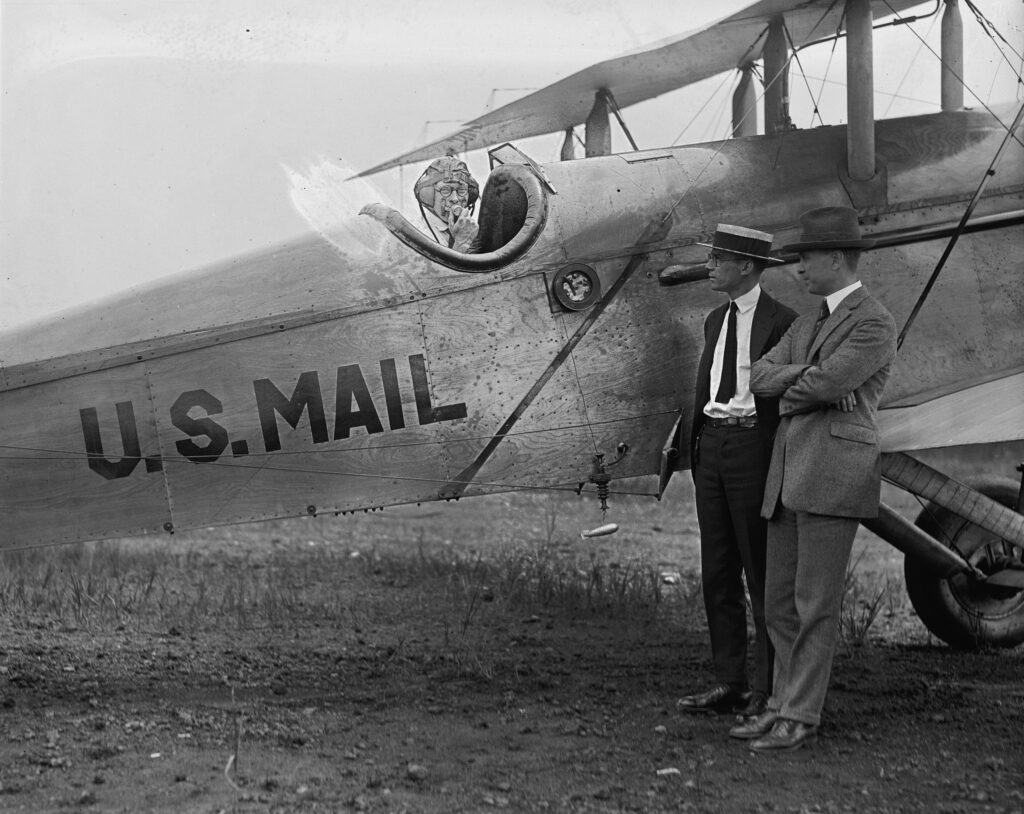
The economic history of commercial airline flight began with courageous pilots and entrepreneurs in the American West. They could hardly have imagined the proliferation of the industry and its low relative costs, safety, and frequent use among Americans of all income levels and backgrounds.
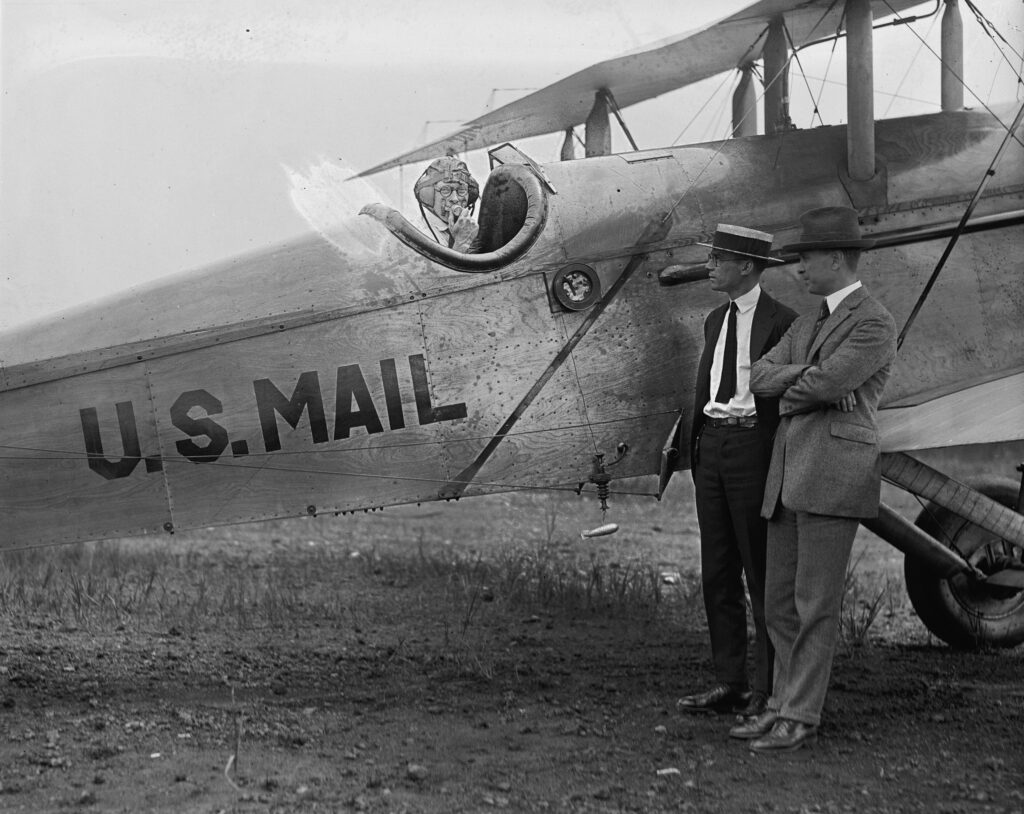
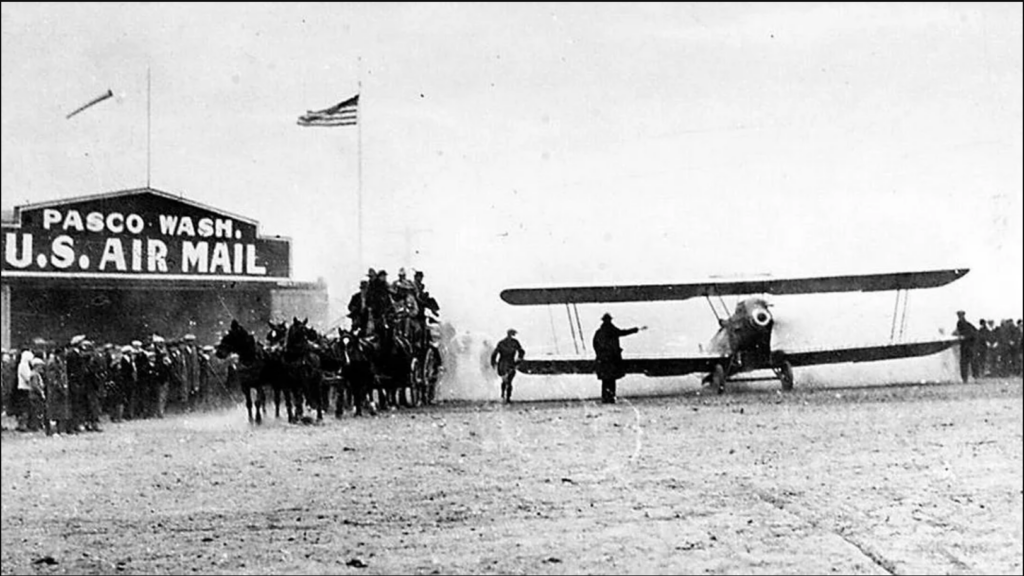
A century ago, Varney Air Lines took flight with a mail delivery that departed Pasco, Washington, headed for Boise, Idaho. Founded by Walter T. Varney (pictured below), who was a part of the US Signal Corps in World War I, the fledgling operation obtained the first airmail contract in 1925 from the US Postal Service.
Varney’s chief pilot was Dewey “Lee” Cuddeback who guided a Laird Swallow biplane from Pasco to Boise in just under three hours, safely landing before a crowd of around two thousand onlookers with 207 pounds of mail in tow. After refueling, he delivered more mail to Elko, Nevada finishing just shy of four-and-a-half hours in the sky. This feat took less than a tenth of the time that traditional railway transport would have taken to deliver the mail and represented an incredible reduction in delivery time.
Later that day, a second pilot, Franklin Rose, ended his flight in a less auspicious way. His leg from Elko to Boise terminated in an emergency landing in a mud-soaked grain field just north of the Nevada-Idaho state line. While Rose walked away unharmed after being blown off course by over sixty miles, the aircraft remained stuck in the mire, bringing an end to the day’s second round of flights. Despite that unfortunate outcome, the stage was being set for modern passenger flight. Four years later, Varney Air Lines was acquired by United Aircraft and Transport Corporation; in 1934 it merged with several other air transport firms to form United Airlines.
The early years of American flight were filled with these harrowing stories of innovation, safety improvements, and rivalrous competition. Through it all, efficiency, safety, and costs improved. One such innovator was Archie League, whose innovations in ground signalling and radio communications paved the way for ever-safer passenger flight. League’s ideas on safety were highly valued in St. Louis, as the flight fever that was spawned by Charles Lindbergh’s exploits attracted more and more pilots to America’s heartland to test their aviation mettle. As air traffic became busier there, League’s safety protocols set the standard for flight safety for takeoffs and landings. Discontented with ground signalling alone, League famously guided a flight bound for St. Louis’s Lambert airfield through severe weather and dense fog with calm and concise directions for a safe landing in October of 1929, sparing the lives of all on board.
In the same month as League’s radio innovation, economic history would take a turn with Black Tuesday’s infamous stock market crash. While the aviation industry was in its infancy, it would soon be smothered by New Deal regulations, preventing the same pace of improvement that had been unleashed by the likes of Varney, League, and Lindbergh. Indeed, the Hoover and FDR administrations delivered an unprecedented rise in the “fatal conceit” of economic planners who attempted to create economic outcomes according to their own wishful thinking. Their restrictions and barriers to entry and exit would do nothing of the sort, and proved to inhibit improvements and price competition in the airline industry for four decades.
With FDR’s creation of the Civil Aeronautics Board (CAB) in 1938, its designers claimed that it would centrally administer, “safety-related rulemaking, accident investigation, and economic regulation of commercial airlines.” Eventually, it would go far beyond such broad claims and do far more than that, engaging in price-fixing and the prevention of new entrants, just to name a few. Ultimately, the hubris of social engineers led them to declare what “fair” prices were across the airline industry.
In a 1975 report, no less than liberal senator Edward Kennedy admitted that “the Board’s experience suggests it is extremely difficult, if not impossible, to develop a cost-based ratemaking system that uses fair procedures and keeps fares in such an industry low.” In a more damning admission, “This is not to say that inherent defects are the only cause of the CAB’s failings. These may, for example, also reflect the human tendency to listen more closely to representatives, such as those for the industry, who are powerful, well-informed, and can reward regulators with future jobs or contracts.”
The ultimate effect of this centralized planning was to “control prices, restrict entry, and confer antitrust immunity.” In brief, the CAB was used to create a government-backed cartel in the interest of existing large carriers. In what amounted to a public confession of crony-capitalism, the CAB’s days were numbered.
In the wake of the report, American Airlines was allowed to discount its fares up to 45 percent in an attempt to see whether airline travel could be “made available at a price all can afford.” Once this mild form of price competition was allowed, rivalrous competition showed suspicious legislators and regulators that allowing competition did indeed create greater value for consumers. Eventually, Senator Howard Cannon along with bipartisan supporters including Ted Stevens and Wendell Ford helped pass the Airline Deregulation Act in February of 1978.
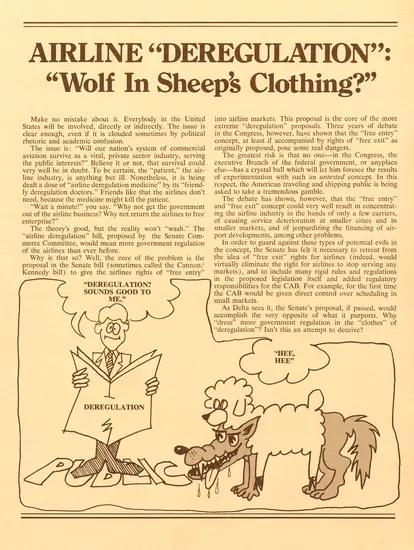
Since industrial leaders at the time, like Delta Airlines, had grown accustomed to the many protections they received under the CAB, they lobbied against the deregulatory move. They made claims that “free entry” and “free exit” were “untested concepts” that would result in the concentration of the industry into the “hands of only a few carriers…causing service deterioration at smaller cities and in smaller markets.” Delta’s doom-mongering didn’t materialize in either the short or long run.
In the nearly 50 years since the abolition of the Civil Aeronautics Board, routes and flexibility have proliferated, and prices have declined continually. In fact, the last three decades have seen inflation-adjusted domestic airfares fall from $614 in 1995 to $397 in 2025. Further, the industry continues to grow, nearly doubling the number of employees since 1990. Prior to deregulation, air travel was undoubtedly a luxury good. Now, it has become so affordable that 80 percent of Americans with annual household income below $50,000 have taken flight at some point in their lives.
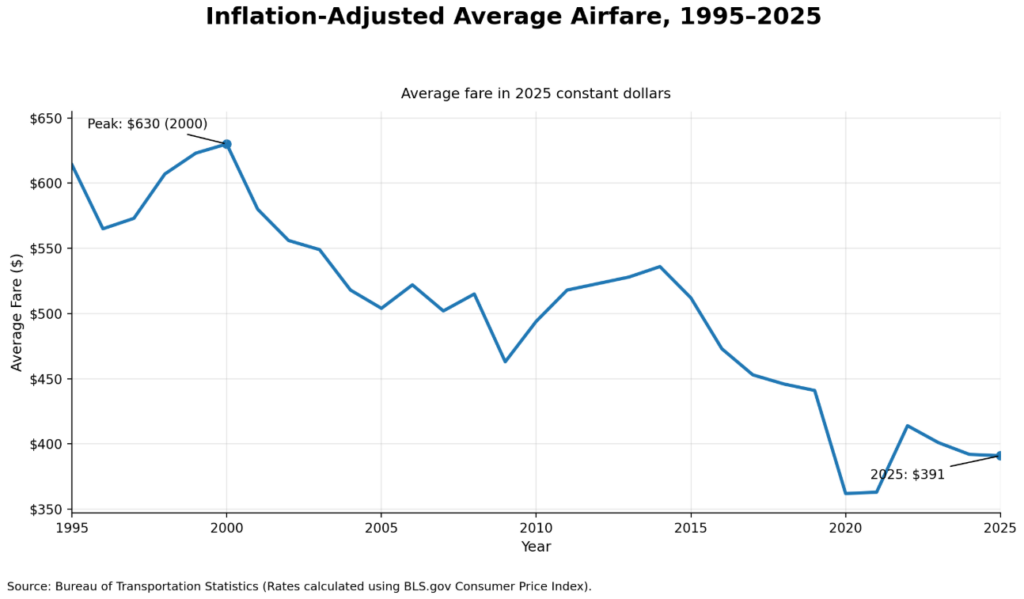
In the 100 years since Varney Air Lines first took on the tremendous risks and costs of delivering a few hundred pounds of mail in the American West, to the amazement of onlookers in Pasco, Boise, and Elko, the industry itself has undergone incredible transformation. Once the purview of daredevils and former combat pilots, the “friendly skies” are now a nearly ubiquitous experience for Americans who, despite the inconveniences of TSA delays and the need for significant reform, continue to vote with their dollars and take flight at lower costs than Varney, League, or Lindbergh would have dared imagine.
That transformation is, in large part, thanks to their own courageous actions and airline deregulation nearly 50 years ago.
